SEO Updates
How to Learn SEO Step by Step: A Complete Beginner’s Roadmap (2026)

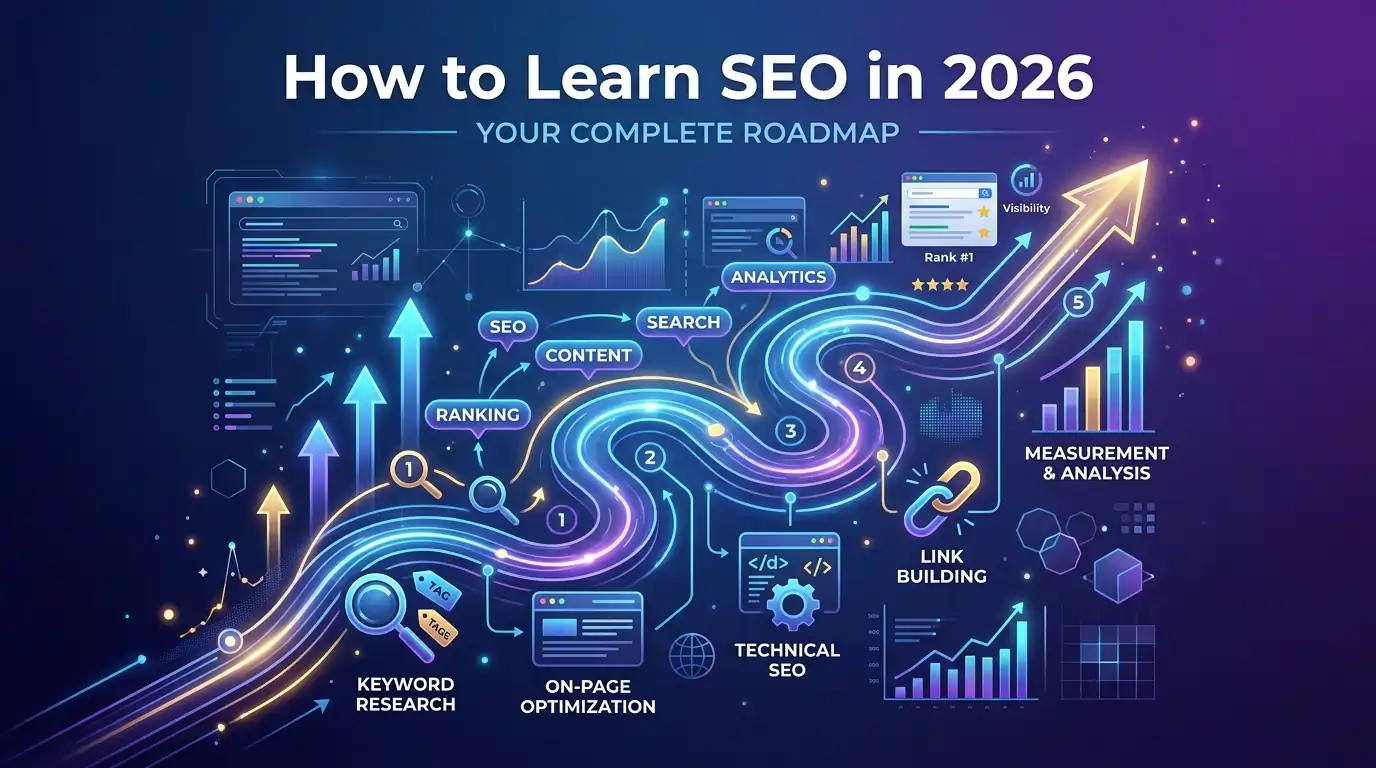
If you have ever searched for something on Google and wondered why certain websites show up first – that is SEO at work. And the good news is, you do not need a computer science degree or years of coding experience to understand it. Anyone can learn SEO with the right roadmap, a little patience, and consistent practice. Whether you are a student trying to build a career, a small business owner who wants more customers online, or a blogger looking to get more readers – knowing how to learn SEO step by step can genuinely change your results on the internet. This guide is written to be your most honest, practical, and beginner-friendly companion on that journey.
By the time you finish reading this, you will have a clear SEO learning roadmap, know which tools to use, how long it realistically takes, and where to get the best training – including from Orphic Solution, one of the most trusted digital marketing and SEO training providers in Bhopal.
What is SEO and Why Should You Learn It in 2026?
SEO stands for Search Engine Optimization. In simple words, it is the practice of making your website better so that search engines like Google, Bing, or Yahoo can understand it, trust it, and show it to people who are searching for what you offer.
Think of it this way – Google has billions of pages to look through every day. SEO is how you raise your hand and say, “Hey, my page answers this question really well.” When done right, your page gets picked over thousands of others and lands on the first page of results.
Now, why does this matter in 2026 specifically? Because the internet is no longer just about having a website. Today, AI-powered search engines like Google’s AI Overviews and Bing Copilot are changing how people find information. If your content is not optimized for how these systems work, you simply do not exist online – no matter how good your product or service is.
Learning how to learn SEO properly right now gives you an edge that very few people have. The demand for SEO professionals is at an all-time high. Businesses of all sizes – from a local restaurant in Bhopal to a global e-commerce brand – need people who understand search engine behavior.
Here is what the opportunity looks like right now:
- SEO is one of the highest-paying digital skills – Entry-level SEO professionals in India earn between ₹3-6 LPA, and experienced ones can earn ₹12-25 LPA or more as consultants.
- Businesses are spending more on organic search – Companies prefer SEO over paid ads because the results are long-lasting and cost-effective in the long run.
- AI tools have made SEO more important, not less – AI is changing search, but human-optimized, trustworthy content is still what these engines reward most.
- The SEO career path is clear and growing – You can become an SEO executive, content strategist, SEO consultant, or even start your own digital agency after mastering these skills.
Who Can Learn SEO – Is It Only for Developers?
This is one of the most common doubts beginners have. The answer is absolutely not – SEO is not just for developers or programmers.
Yes, there is a part of SEO called Technical SEO that involves some understanding of website structure, page speed, and code. But even that does not require you to become a web developer. Most technical SEO tasks today can be done using simple tools with no coding needed.
Here is who can benefit from an SEO learning guide like this one:
- Students who want to build a marketable digital skill before entering the job market
- Small business owners who want to bring more customers to their websites without spending money on ads every month
- Content writers and bloggers who want their articles to rank on Google and get consistent traffic
- Marketing professionals who want to understand how organic search fits into the bigger digital strategy
- Entrepreneurs and freelancers who want to grow their personal brand or client base online
The only things you really need to start are basic internet knowledge, the ability to read and write well, and a genuine curiosity about how things work online. That is it.
Which Skills Do You Need Before Starting Your SEO Journey?
Before jumping into any SEO course or tutorial, it helps to have a few foundational skills in place. Not because SEO is hard, but because these basics make the whole SEO training experience much smoother.
Here are the skills worth developing before you begin:
- Reading and writing clearly – SEO involves creating content that real people actually want to read. If you can express ideas simply and clearly, you are already ahead of most people.
- Basic use of Google products – Knowing how to navigate Google Search, Google Docs, and Google Sheets will save you a lot of time since many SEO tools connect to the Google ecosystem.
- Curiosity and research habits – SEO is always changing. People who enjoy looking things up, testing ideas, and learning from results tend to do very well in this field.
- Basic understanding of websites – You do not need to build websites, but knowing what a URL is, what a blog post looks like, and what a homepage does will give you a head start.
- Consistency – This is honestly the most underrated skill. SEO results take time. People who show up every week and keep learning tend to see the best outcomes.
Also Read – Why Digital Marketing is the Best Career Option in 2026
How to Learn SEO: The Step-by-Step Roadmap for Beginners
Now we get to the heart of this guide. If you have been searching for a practical SEO beginner roadmap – something that does not just list buzzwords but actually tells you what to do and in what order – you are in the right place.
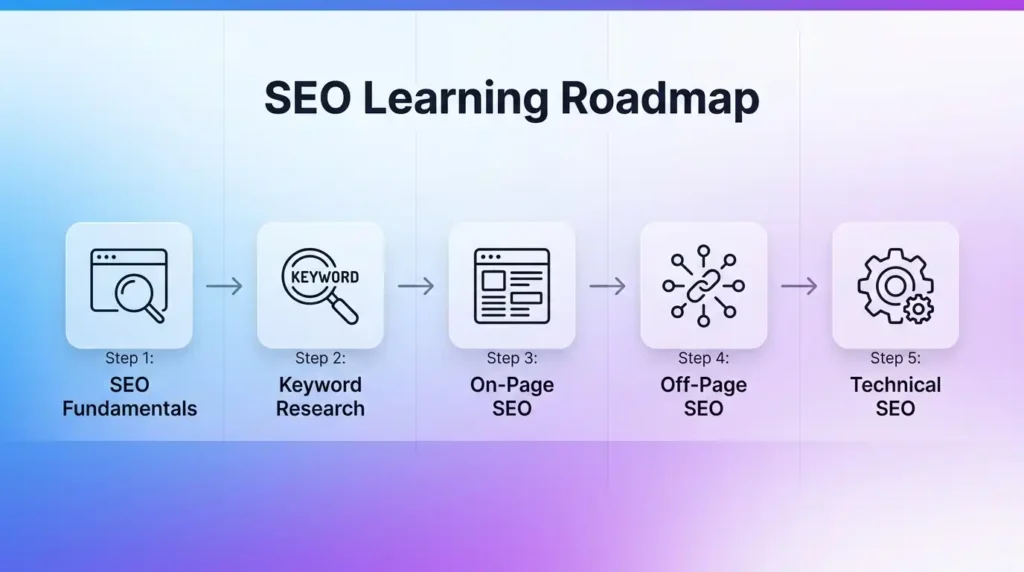
This roadmap is built on five core phases. Each phase builds on the previous one, so it is important not to skip ahead. Think of it like building a house – you cannot put up walls before laying the foundation.
Here is the SEO course roadmap at a glance before we go deeper:
| Phase | Focus Area | Estimated Time |
| Phase 1 | SEO Fundamentals | Week 1-2 |
| Phase 2 | Keyword Research | Week 3-4 |
| Phase 3 | On-Page SEO | Week 5-6 |
| Phase 4 | Off-Page SEO | Week 7-8 |
| Phase 5 | Technical SEO | Week 9-10 |
Let us go through each one properly.
Step 1 – How to Understand SEO Fundamentals First
Before you touch any tool or write a single word of content, you need to understand how search engines actually work. This is the step most beginners skip – and it is also why many of them plateau early.
Here is what the fundamentals phase covers:
- Crawling – Search engines use bots (also called spiders or crawlers) to browse the internet and find web pages. They follow links from one page to another and collect data about each page they visit.
- Indexing – Once a page is crawled, Google decides whether to store it in its index. Think of the index as a massive library. If your page is in the library, it can show up in search results. If it is not, no one will find it through Google.
- Ranking – When someone searches for something, Google looks through its index and uses hundreds of signals to decide which pages to show and in what order. Your SEO work is essentially trying to send the right signals.
- The three types of SEO – On-page SEO (what is on your website), Off-page SEO (what other websites say about you), and Technical SEO (how your website is built). All three matter.
The best SEO learning guide always starts here because without this mental model, all the tools and tactics you learn later will feel random.
Step 2 – When Should You Start Keyword Research Practice?
Keyword research should start from week three of your SEO study plan – right after you have a solid grip on the fundamentals. This is not something you do once and forget. It is an ongoing skill that you will use throughout your entire SEO career.
Keywords are the words and phrases people type into Google. When you know what your audience is searching for, you can create content that directly matches their needs – and that is when rankings start to happen.
Here is how to approach keyword research as a beginner:
- Start with seed keywords – These are broad, general terms related to your topic. For example, if you run a bakery in Bhopal, your seed keyword could be “bakery in Bhopal” or “birthday cakes.”
- Use free tools to expand your list – Tools like Google Keyword Planner, Ubersuggest, and Google’s autocomplete feature are great starting points. They show you related terms, how many people search for them each month, and how competitive they are.
- Focus on long-tail keywords first – These are longer, more specific phrases like “best eggless birthday cake in Bhopal” instead of just “birthday cake.” They have lower competition and are easier to rank for as a beginner.
- Check search intent – For every keyword, ask yourself: what does the person searching this actually want? Do they want information, want to buy something, or are they looking for a specific website? Your content must match that intent.
One of the biggest competitor gaps we see in most SEO tutorials is that they teach you how to find keywords but not how to think about them. Keyword research is really about understanding people – what they need, when they need it, and how they ask for it.
Step 3 – Where to Apply On-Page SEO Techniques
On-page SEO is where everything you have learned starts to get applied directly to your website. This is also the step where most beginners start seeing real results for the first time.
On-page SEO covers everything that is physically on your web page – the text, the headings, the images, the links, and the structure. Here is where to apply it:
- Title tags – This is the blue clickable heading you see in Google search results. It should include your main keyword and be written in a way that makes people want to click. Keep it under 60 characters.
- Meta descriptions – The short paragraph below the title in search results. It does not directly impact rankings but affects how many people click your link. Write it to answer the searcher’s question in 150-160 characters.
- Headings (H1, H2, H3) – Use your primary and secondary keywords naturally in your headings. This helps Google understand the structure and topic of your page. Your H1 should always include the main keyword.
- Content quality – Write content that genuinely answers the question being asked. Google’s EEAT algorithm (which stands for Experience, Expertise, Authoritativeness, and Trustworthiness) rewards pages that show real knowledge, not just keyword-stuffed paragraphs.
- Internal links – Link to other relevant pages on your website. This helps Google understand how your pages relate to each other and keeps visitors on your site longer.
- Image optimization – Add alt text to every image you use. Alt text is a short description that tells search engines what the image shows. It also helps visually impaired users understand your content.
On-page SEO is where your SEO beginner tips come to life practically. Start here and build good habits from the beginning.
Step 4 – Which Off-Page SEO Strategies Work Best for Beginners?
Off-page SEO refers to everything that happens outside your website but still affects how Google sees you. The most important signal here is backlinks – links from other websites that point to yours.
When a respected website links to your page, Google treats it as a vote of confidence. The more quality votes you have, the more authority your site builds, and the higher it can rank.
Here are the off-page SEO strategies that actually work for beginners without needing a huge budget:
- Guest posting on relevant blogs – Write a useful article for another website in your niche and include a link back to your site. This is one of the most reliable ways to build authority as a new website.
- Business directory listings – Submit your website to trusted directories like Google My Business, Justdial, and IndiaMART (especially for local businesses). These links may not be glamorous, but they help establish your presence.
- Social media sharing – While social media links are “no-follow” (meaning they do not pass direct ranking power), they drive real traffic to your website, which sends positive signals to Google.
- Brand mentions – When other websites mention your brand name even without linking to you, Google can still pick up these signals. Building a genuine online presence helps this happen naturally.
- Creating shareable content – Infographics, how-to guides, original research, and detailed tutorials are the kinds of content that people naturally want to link to. Focus on creating something genuinely useful, and links will come.
These SEO training methods do not require advanced skills – just a willingness to reach out, collaborate, and produce helpful content.
Step 5 – Is Technical SEO Important at the Beginner Stage?
Yes – but you do not need to master it right away. Technical SEO is important because even the best content will not rank if search engines have trouble accessing or understanding your website. However, the good news is that most beginners only need to understand a handful of basics at this stage.
Here is what you actually need to know as a beginner:
- Page speed – Google uses page speed as a ranking factor. A slow website frustrates users and gets pushed down in results. Use Google’s free PageSpeed Insights tool to check yours and fix any obvious issues.
- Mobile-friendliness – More than 60% of all searches now happen on mobile devices. Your website must look and work well on a smartphone. Most modern website builders (like WordPress) handle this automatically.
- SSL certificate (HTTPS) – If your website URL starts with “http” instead of “https,” that is a red flag for Google. Make sure your site has a valid SSL certificate. Most hosting providers include this for free.
- XML sitemap – A sitemap is a file that lists all your website’s pages in one place, making it easier for Google to crawl and index them. You can generate one automatically with free plugins like Yoast SEO.
- Robots.txt – This is a simple file that tells search engine crawlers which parts of your website they are allowed to visit. Make sure yours is not accidentally blocking important pages.
When it comes to SEO learning duration, most beginners can handle these technical basics within their first two months of study.
Also Read – How to Start a Digital Marketing Career After 12th: Complete Roadmap for Students
What Are the Best SEO Learning Resources in 2026?
One of the biggest questions people have when they decide to learn SEO is: where do I actually go to learn it properly? The internet is full of SEO tutorials, but a lot of them are outdated, overly complicated, or trying to sell you something overpriced.
Here is an honest look at the best resources available today, based on quality, accuracy, and beginner-friendliness:
| Resource | Type | Best For |
| Google Search Central | Documentation | Understanding how Google actually works |
| Ahrefs Academy | Video course | Practical keyword and link-building skills |
| Moz Beginner’s Guide | Written guide | End-to-end SEO overview |
| Semrush Academy | Course + certificate | Tool-based learning |
| HubSpot SEO Course | Video + quiz | Structured beginner training |
| Orphic Solution Training | Guided program | Hands-on learning with real projects in Bhopal |
| Neil Patel’s Blog | Articles | Strategy and latest SEO trends |
| YouTube (Backlinko, Moz) | Videos | Visual, example-based learning |
The best way to learn SEO is to combine free resources with structured practice. Read from Google Search Central to understand the rules. Watch YouTube tutorials to see them applied. Then actually practice on a real website.
Which Free SEO Courses Are Best for Absolute Beginners?
If you are just starting out and do not want to spend money right away, here are the best free options to begin your SEO training:
- Google’s SEO Starter Guide – This is the most accurate and up-to-date SEO tutorial available because it comes directly from Google. It explains how Google crawls, indexes, and ranks pages in plain language. Start here.
- HubSpot SEO Certification Course – This free course covers everything from keyword research to link building and content strategy. It includes video lessons and a certification exam. The SEO course benefits here are real – it teaches both strategy and execution.
- Semrush Academy – Offers multiple free SEO courses ranging from beginner to advanced. Each course ends with a quiz and a certificate. Particularly strong on keyword research and competitive analysis.
- Ahrefs’ Free SEO Course for Beginners – Hosted on YouTube and the Ahrefs website, this course is practical, clear, and built for people who have never done SEO before. It is one of the best free SEO course guides available.
All of these are completely free and beginner-friendly. You can go through all four in about 4-6 weeks if you dedicate a few hours each week to studying.
Is an SEO Certification Worth It for Your Career?
This is a question that comes up a lot – and the honest answer is: it depends on what you do with it.
An SEO certification from Google, HubSpot, or Semrush does add credibility to your resume, especially when you are just starting out and do not yet have a portfolio of results to show. It signals to employers and clients that you have at least gone through a structured SEO course guide and understand the basics.
However, certifications alone do not get you hired or win you clients. What actually matters is your ability to get results. Employers and clients want to see real examples – a website you improved, rankings you moved, traffic you grew.
The best approach is this: use free certifications as a learning tool and a confidence booster, but pair them with hands-on practice. Build a blog, optimize it, track its rankings over a few months, and document your results. That portfolio of real work is worth more than any certificate.
If you want both – structured learning and real-world practice together – that is exactly what Orphic Solution’s training program is designed for.
Also Read – 7 Proven Techniques of the Best Digital Marketing Company in Bhopal
How Long Does It Take to Learn SEO? Realistic Timeline Explained
This is one of the most common PAA questions on Google for good reason – people want to know if learning how to learn SEO is a short sprint or a long marathon. The truth is somewhere in between.
Here is a realistic breakdown of what to expect at each stage:
| Stage | Timeframe | What You Can Do |
| Absolute Beginner | 0-30 days | Understand how search engines work, basic keyword research, on-page SEO basics |
| Beginner | 1-3 months | Run basic SEO audits, optimize existing content, build simple link profiles |
| Intermediate | 3-6 months | Create keyword strategies, manage an entire website’s SEO, report on organic traffic growth |
| Confident Practitioner | 6-12 months | Handle client projects, lead SEO campaigns, train junior team members |
| Expert | 12+ months | Build your own SEO playbook, specialize in technical or e-commerce SEO, consult independently |
A few important things to note about your SEO learning duration:
- How fast you progress depends heavily on how much time you put in each week. Someone studying 10 hours a week will progress much faster than someone doing 1 hour a week.
- Hands-on practice accelerates learning dramatically. The people who progress fastest are the ones applying concepts to real websites, not just reading about them.
- SEO results themselves take time. Even if you do everything right, Google typically takes 3-6 months to reflect major ranking changes. This is normal – do not give up during this period.
The key message in every SEO learning guide worth reading is this: consistency over speed. Show up regularly, apply what you learn, and results will follow.
Can I Learn SEO Myself Without Joining a Course?
Yes, you absolutely can – and many excellent SEO professionals are entirely self-taught. The internet has made it possible to access world-class SEO knowledge completely free of charge.
That said, self-learning SEO without any structure is also where most people get stuck. They read a few articles, feel overwhelmed by contradictory advice, try a few things that do not work immediately, and give up. The best way to learn SEO on your own is to give yourself a structure even when no one is forcing you to follow one.
Here is a 90-day self-study plan you can follow right now:
Month 1 – Build Your Foundation
- Week 1-2: Read Google’s SEO Starter Guide completely and take notes
- Week 3-4: Complete one free beginner SEO course (HubSpot or Ahrefs)
- Daily habit: Follow one SEO blog (Moz, Search Engine Journal, or Orphic Solution’s blog) and read one article per day
Month 2 – Practice on a Real Website
- Set up a free WordPress blog on any topic you genuinely enjoy
- Write 4-6 blog posts using keyword research and on-page SEO principles
- Connect the site to Google Search Console and Google Analytics
Month 3 – Analyze and Improve
- Review your Search Console data – which pages are getting impressions? Which ones have clicks?
- Improve your weakest pages based on what the data tells you
- Start building basic backlinks through directory listings and social profiles
This SEO study plan gives you a genuine foundation in 90 days. If you want to move faster or with more guidance, that is where formal SEO training methods – like those offered by Orphic Solution – can make a real difference.
How to Build a Practice Website to Apply Your SEO Skills
The single best thing you can do to accelerate your SEO skills training is to build a practice website. There is no substitute for learning by doing.
Here is how to set one up without spending much money:
- Choose a niche you actually care about – Pick a topic you would happily write 20 articles about. Food, fitness, travel, local businesses, parenting, technology – anything works. Your genuine interest will come through in the writing quality, which matters for SEO.
- Use WordPress on free hosting or affordable shared hosting – WordPress.com has a free tier that works for practice. If you want more control, shared hosting from providers like Hostinger or Bluehost costs around ₹80-150 per month.
- Install Yoast SEO or Rank Math – These free WordPress plugins guide you through on-page SEO for every post you write. They check your keyword usage, readability, meta descriptions, and more.
- Write consistently and track everything – Publish at least 2-3 new posts per week. Connect Google Search Console and watch how Google slowly discovers and ranks your content. The data you collect is worth more than any SEO textbook.
This approach – building, writing, tracking, improving – is the foundation of every successful SEO professional’s real-world education.
Also Read – Top 10 SEO Mistakes That Could Be Hurting Your Website
What SEO Tools Should Every Beginner Know in 2026?
A big part of how to learn SEO effectively is learning the tools. You do not need expensive software to start. There are powerful free tools that do most of what a beginner needs – and a few affordable paid tools worth investing in once you are ready to go deeper.
Here is a complete beginner’s toolkit:
| Tool | Type | Cost | What It Does |
| Google Search Console | Analytics | Free | Shows how your site appears in Google, which keywords bring traffic, technical issues |
| Google Analytics 4 | Analytics | Free | Tracks who visits your site, where they come from, what they do on your pages |
| Google Keyword Planner | Keyword Research | Free | Shows search volumes and keyword ideas |
| Ubersuggest | All-in-one | Free (limited) | Keyword research, site audit, backlink data |
| Yoast SEO (WordPress) | On-page | Free | Guides on-page optimization for every page |
| Screaming Frog (free version) | Technical | Free (500 pages) | Crawls your site for technical issues |
| AnswerThePublic | Content ideas | Free (limited) | Shows questions people ask around a topic |
| Google Trends | Research | Free | See how interest in a topic changes over time |
Which Google Tools Are Free and Most Useful for SEO Beginners?
Of all the tools listed above, the two Google tools that every beginner should set up immediately are:
- Google Search Console – This is non-negotiable. It shows you exactly how Google sees your website. You can submit your sitemap, check which pages are indexed, see which keywords are bringing impressions and clicks, and identify technical errors. It is the closest thing to a direct conversation with Google about your website’s health.
- Google Analytics 4 – Once your site starts getting traffic, GA4 tells you everything about your visitors – where they came from, how long they stayed, which pages they read, and where they left. This data is what separates good SEO decisions from guesswork.
Both tools are completely free and can be set up in under 30 minutes. Use them together and you will have more SEO insight than most small businesses in India.
How Orphic Solution Helps You Learn SEO Faster in Bhopal
If you are based in Bhopal or Central India and want to learn SEO with real guidance, real projects, and real mentorship – Orphic Solution is the right place for you.
Founded in 2017, Orphic Solution has been helping businesses grow online through SEO, web development, and digital marketing for nearly a decade. What makes their training different from a random online course is that you do not just study theory – you work on live projects and see actual results.
Here is why many students and professionals choose Orphic Solution for their SEO training guide:
- Real project experience – You do not practice on dummy websites. You work on actual client campaigns, which means you understand what SEO looks like in the real world – the pressure, the timelines, the reporting, and the wins.
- Expert trainers with live industry experience – The team at Orphic Solution manages live SEO campaigns every day. Their trainers are not just teachers – they are active SEO practitioners who know what is working right now in 2026.
- Structured SEO course roadmap – Their training follows a clear step-by-step curriculum that covers everything from fundamentals to technical SEO to client management. No jumping around. No confusion.
- Local market understanding – Being based in Bhopal, they understand the local business landscape deeply. If your goal is to serve clients or grow a local business in Madhya Pradesh, this contextual knowledge is genuinely valuable.
- Ongoing support and career guidance – SEO is not something you master in a week. Orphic Solution provides continued support, feedback, and guidance even after the training ends.
Whether you want to start a career in digital marketing, grow your own business online, or offer SEO services as a freelancer – their SEO training guide 2026 gives you the practical foundation and real-world experience to do it confidently.
You can explore their training program at training.orphicsolution.com or reach out to them directly at +91 99937 72685.
Conclusion: Start Your SEO Learning Journey Today
Learning SEO is one of the most valuable things you can do for your career or business in 2026. It is not reserved for tech experts or big marketing agencies. With the right SEO beginner roadmap, a genuine practice habit, and the right tools, anyone can build real skills that translate into real results.
Here is a quick recap of everything we covered in this guide on how to learn SEO step by step:
- Start with understanding how search engines crawl, index, and rank pages – this mental model makes everything else click
- Move into keyword research early and practice it consistently using free tools
- Apply on-page SEO to every page you create – title tags, headings, content quality, internal links
- Build your off-page presence through guest posting, business listings, and shareable content
- Learn the technical basics – page speed, mobile, HTTPS, sitemaps – without getting overwhelmed
- Use free resources like Google Search Central, HubSpot, and Ahrefs to build your knowledge base
- Build a practice website and apply everything you learn in real time
- Track results with Google Search Console and Analytics from day one
The SEO career path is open to anyone willing to put in the work consistently. You do not need to figure it all out in one day – just take the next step.
And if you are ready to go from beginner to confident SEO practitioner with hands-on training and real project experience, Orphic Solution in Bhopal is here to guide you every step of the way.
Your digital journey starts today. Take the first step.
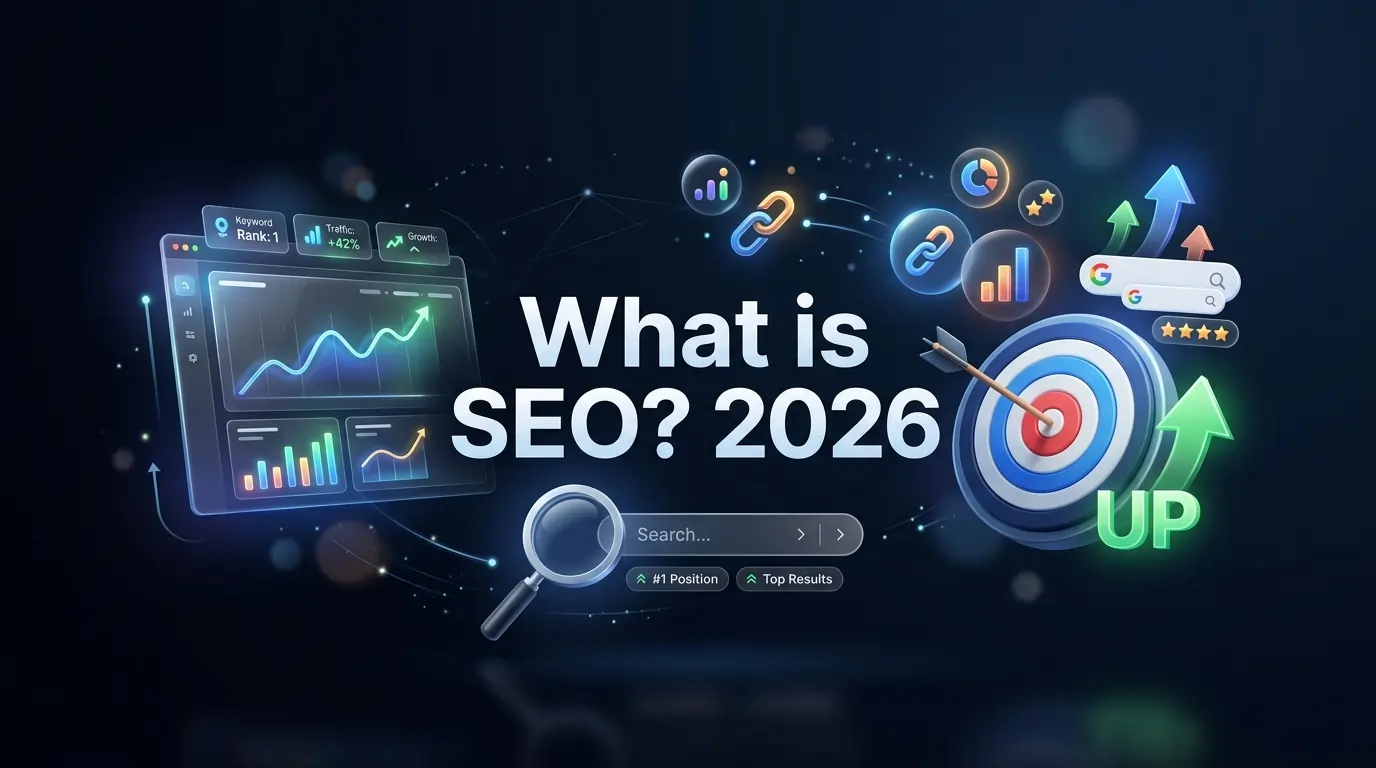
Did you know that 93% of all online experiences begin with a search engine? That is a massive number. And yet, most small businesses in India are still not taking advantage of one of the most powerful tools available to them. If you have a website but it is not showing up on Google, you are losing potential customers every single day. The reason? You are probably not using SEO. So, what is SEO? What is SEO really about, and why does every business owner need to understand it? You are in exactly the right place to find out.
What is SEO – or Search Engine Optimization – is the process of making your website visible on search engines like Google. In simple terms, it helps your website show up when someone searches for something related to your business or service.
Let us start from the very beginning.
What is SEO? Meaning and Definition in Simple Words
Before anything else, let us answer the most basic question – what is SEO?
SEO stands for Search Engine Optimization. The SEO meaning, in the simplest possible way, is this: it is the practice of improving your website so that it ranks higher on search engines like Google, Bing, or Yahoo.
Think of Google as a giant library. When someone searches for something, Google’s job is to find the most relevant, helpful, and trustworthy pages from billions of websites and show them to that person. SEO is the process of helping Google understand that your website is useful, accurate, and worth showing to people.
SEO Full Form – What Does Search Engine Optimization Actually Mean?
Let us break it down word by word:
- Search Engine – Google, Bing, Yahoo – these are tools people use to search for information online.
- Optimization – The process of improving something to make it perform better.
So, Search Engine Optimization literally means: improving your website in a way that helps search engines find it, understand it, and show it to the right people at the right time.
What is SEO introduction without a real example? Here is one. Imagine you own a bakery in Bhopal. When someone types “best cake shop in Bhopal” on Google, you want your website to appear on the first page. SEO is what makes that happen.
Is SEO Paid or Free? Organic vs Paid Search – Know the Difference
This is one of the first questions beginners ask. The honest answer: SEO is free in the sense that you do not pay Google to show your website in organic results. However, SEO requires time, consistent effort, and sometimes investment in tools or professionals.
Search engine results pages show two types of results:
- Organic Results – These are unpaid results earned through SEO. They are more trusted by users.
- Paid Results (PPC/Ads) – These are advertisements that businesses pay for every time someone clicks.
SEO focuses entirely on organic visibility. It takes more time than paid ads but the results last much longer and deliver a far better return on investment over time.
Also Read – Why Digital Marketing is the Best Career Option in 2026
Why is SEO Important for Your Business? (5 Powerful Reasons)
Now that you understand what is SEO, the obvious next question is – why does it matter so much? Here are five solid reasons why SEO is important for any business that wants to grow online.
1. More Organic Traffic – When your website ranks on page one of Google, more people see it and click on it. Research shows that the first organic result on Google gets nearly 28% of all clicks.
2. Free, Long-Term Traffic – Unlike paid ads that stop the moment you stop paying, SEO keeps bringing visitors to your website 24/7, 365 days a year, without extra cost.
3. Builds Trust and Credibility – People trust websites that appear on the first page of Google. High rankings naturally build brand trust in the minds of potential customers.
4. Better ROI Than Any Other Channel – SEO consistently delivers the highest return on investment compared to paid ads, social media, or email marketing – especially over the long term.
5. Competitive Advantage – If your competitor is doing SEO and you are not, they are getting all the customers that could have been yours. SEO keeps you in the race.
Who Needs SEO? Every Business That Wants to Grow Online
SEO is not just for big brands and tech companies. A local restaurant in Bhopal, a small clothing store, a startup with ten employees, a real estate agent, a hospital, a freelance designer – anyone who wants customers to find them online needs SEO. If your customers use Google to look for what you offer, then SEO is non-negotiable for you.
What Happens When You Don’t Do SEO?
Without SEO, your website sits in the dark – unseen by search engines and invisible to your potential customers. Your competitors who invest in SEO take all the traffic. You miss out on leads, sales, and brand awareness every single day. In today’s digital world, not doing SEO is not a neutral decision – it is choosing to be invisible online.
How Does SEO Work? Step by Step Process Explained
So you now know what is SEO and why it matters. But how does SEO work step by step? To understand this, you need to understand how search engines – specifically Google – process websites.
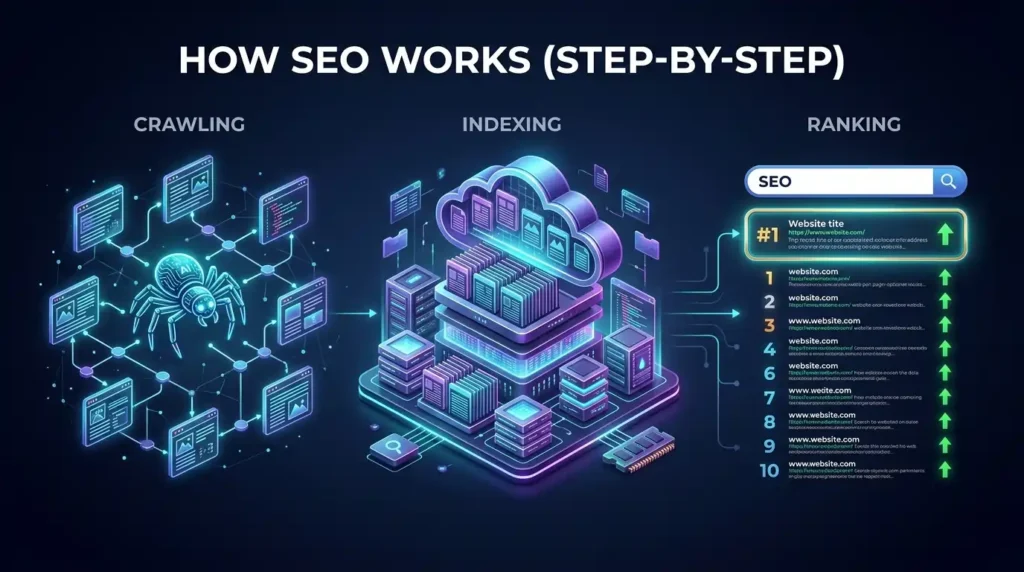
Google uses a three-step process to find, store, and rank web pages. Let us walk through each step.
Step 1: Crawling – How Do Search Engines Find Your Website?
Google uses special automated programs called “crawlers” or “spiders” to explore the internet. These crawlers constantly visit websites, read the content on each page, and follow links to discover new pages.
Think of Google’s crawler like a scout who visits every corner of a city and makes a note of what exists where. If the scout cannot reach your building – your website – they cannot report back to headquarters that it exists.
This is why your website needs to be technically accessible, fast, and properly structured. If Google’s crawlers get blocked or confused by your website’s setup, your content will never get discovered – no matter how good it is.
Step 2: Indexing – How Does Google Store Your Content?
Once Google’s crawler reads your page, it stores the information in a huge database called the Google Index. Think of the index as Google’s giant catalog of all the web pages it has read and stored.
When your page is indexed, it becomes eligible to appear in search results. Without indexing, your website simply does not exist in Google’s world.
You can check if your website is indexed by typing “site:yourwebsite.com” in Google’s search bar. If results appear, your pages are indexed. If not, you have a technical SEO problem to fix.
Step 3: Ranking – Which Factors Decide Who Appears on Page 1 of Google?
Once a page is indexed, Google’s algorithm ranks it based on hundreds of factors. Here are the most important SEO fundamentals that influence ranking:
- Relevance – Does your content closely match what the user searched for?
- Content Quality – Is your content helpful, original, well-written, and thorough?
- Domain Authority – Do other trusted websites link back to yours?
- User Experience – Is your website fast, mobile-friendly, and easy to navigate?
- Keyword Optimization – Are relevant keywords used naturally throughout your content?
- E-E-A-T – Does your content show Experience, Expertise, Authoritativeness, and Trustworthiness?
Understanding how SEO works step by step makes it easier to know where to focus your efforts and why each piece of the puzzle matters.
Also Read – How to Start a Digital Marketing Career After 12th: Complete Roadmap for Students
What Are the Types of SEO? (4 Types Every Beginner Must Know)
A complete SEO introduction always includes the types of SEO. There are four main types. Every beginner needs to understand what each one does before getting started.
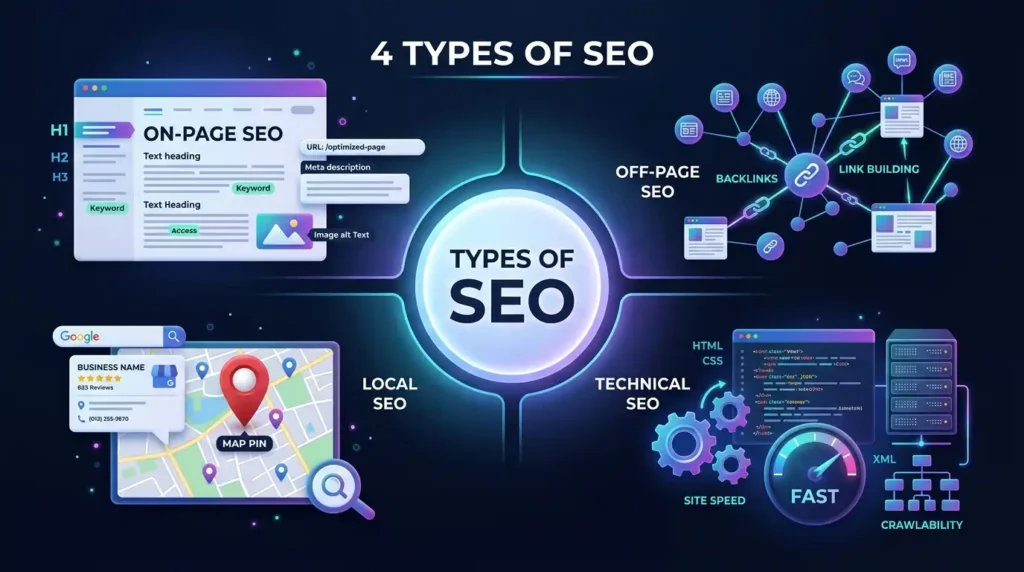
Type 1: What is On-Page SEO? (Definition + Examples)
On-page SEO meaning refers to all the optimization you do directly on your website to help search engines understand your content and help users have a great experience.
Key on-page SEO activities include:
- Using the right keywords in your page title, headings (H1, H2, H3), and throughout your content
- Writing high-quality, original, helpful content that fully answers the user’s question
- Writing clear meta titles and meta descriptions for every page
- Using internal links to connect related pages on your website
- Optimizing image file names and adding alt text with keywords
- Making content easy to read with short paragraphs, bullet points, and clear headings
On-page SEO is entirely in your control and is the best starting point for any beginner. It is the foundation of how search engine optimization works.
Type 2: What is Off-Page SEO? (Backlinks and Brand Authority)
Off-page SEO meaning covers everything you do outside your website to improve its authority and credibility in the eyes of search engines.
The most important off-page SEO activity is backlink building. A backlink is when another website links to your website. Google sees these links as “votes of confidence.” The more quality websites that link to you, the more authority your website gains – and the higher it can rank.
Other off-page SEO activities include:
- Guest blogging on reputable websites in your industry
- Getting listed in trusted online directories
- Building brand mentions and press coverage
- Earning positive reviews on Google and other platforms
- Social media sharing and engagement
Off-page SEO takes time to build but is one of the strongest trust signals for Google.
Type 3: What is Technical SEO? (Website Health Optimization)
Technical SEO focuses on the behind-the-scenes health of your website. The goal is to make sure search engine crawlers can easily access, understand, and index every page on your site.
Technical SEO basics include:
- Website speed – Pages that load in under 2-3 seconds perform significantly better in rankings
- Mobile-friendliness – Over 60% of searches happen on mobile, so your site must work perfectly on small screens
- SSL Certificate (HTTPS) – A secure website is both a Google ranking factor and a trust signal for users
- XML Sitemap – A map of all your website pages that helps Google find and index them faster
- Fixing crawl errors – Broken links, duplicate content, and redirect issues that confuse Google
Type 4 (Bonus): What is Local SEO? (How Businesses in Bhopal Rank Locally)
Local SEO helps businesses appear in search results for location-specific queries. For example, when someone searches “digital marketing company in Bhopal” or “SEO agency near me,” local SEO is what makes a business show up in those results.
This type is especially important for small and medium businesses that serve a specific city or region. Local SEO involves:
- Optimizing your Google Business Profile with accurate information
- Adding your business address, phone number, and hours consistently across the web
- Getting local customer reviews on Google
- Using location-based keywords like “SEO company in Bhopal” or “web design Madhya Pradesh” in your content
Local SEO is one of the fastest ways for brick-and-mortar businesses to see real results from their SEO efforts.
Also Read – What is Digital Marketing? Complete Beginner Guide (2026)
SEO Fundamentals – 4 Key Pillars Every Beginner Must Understand
What is SEO without its foundational pillars? Incomplete. Before diving into execution, you need to understand the four SEO fundamentals that hold every successful SEO strategy together.
Pillar 1: Keyword Research – Which Keywords Should You Target?
Keyword research is the process of identifying the exact words and phrases your target audience uses when searching on Google. You need to know what people are searching for before you create content around it.
For example, a bakery owner in Bhopal should know that people search for “birthday cake delivery Bhopal” or “best bakery near me Bhopal.” These are the keywords to target.
Good keyword research looks at:
- Search Volume – How many people search for this term per month?
- Keyword Difficulty – How competitive is this keyword? Can a new website realistically rank for it?
- Search Intent – What does the person actually want when they search this? Information? To buy something?
Free tools like Google Keyword Planner, Ubersuggest, and Google Search Console are great starting points for keyword research.
Pillar 2: Content Creation – Why Quality Content is the Heart of SEO
Google’s main goal is to give users the most helpful and relevant answer to their question. The best way to align with that goal is to create content that genuinely helps your audience – and does it better than anyone else.
Quality SEO content should:
- Answer the user’s question clearly, completely, and honestly
- Be written in simple language that anyone can understand
- Include the right keywords placed naturally – never forcefully
- Be well-structured with clear headings, short paragraphs, and helpful examples
- Be unique and original – not copied or closely paraphrased from other sources
Content is what SEO is built on. Without great content, no amount of technical optimization or link building will produce lasting results.
Pillar 3: Backlinks – How Do Other Websites Help You Rank Higher?
A backlink is a link from another website to your website. Backlinks are one of Google’s most important ranking signals. They act like votes – the more quality votes (backlinks) your website receives from trusted sources, the more authority Google assigns to your site.
One backlink from a reputable news website, government site, or established industry blog can be worth more than 100 links from random, low-quality sites. Quality always beats quantity in backlink building.
Pillar 4: Page Speed and Mobile Optimization – Why Google Cares?
Google introduced the Core Web Vitals update specifically to reward websites that provide a fast, stable, and smooth experience for users. If your website is slow to load or difficult to use on a mobile phone, Google will rank you lower – regardless of how good your content is.
A simple check: use Google’s free PageSpeed Insights tool to see how your website scores. Aim for a score above 80 on both mobile and desktop.
Where is SEO Used? Industries That Benefit Most from SEO
SEO is not limited to one type of business or industry. It is used across virtually every sector where customers search online before making a decision. Here are some of the top industries where SEO delivers strong results:
- E-commerce – Product pages optimized for buying keywords drive direct sales
- Healthcare – Hospitals and clinics appear for “doctor near me” and specialist searches
- Real Estate – Properties rank for location-specific searches like “flat for sale in Bhopal”
- Hospitality – Hotels and restaurants get discovered through local search queries
- Education – Institutes rank for course and admission-related searches
- Digital Marketing – Agencies like Orphic Solution rank for “SEO company in Bhopal” and related searches
- Finance – Banks, loan providers, and investment platforms rank for financial query searches
Which Types of Businesses Need SEO the Most?
Any business that wants customers to find them online needs SEO. But businesses that depend heavily on local customers, online discovery, or high-consideration purchases benefit the most. If you are a service-based business in a competitive local market – SEO is your single most powerful digital marketing tool.
Also Read – Top 10 SEO Mistakes That Could Be Hurting Your Website
Which SEO Tools Should Beginners Use? (Free + Paid List)
You do not need expensive software to start SEO. Here is a practical SEO tools list categorized by free and paid options.
Free SEO Tools Every Beginner Should Start With
- Google Search Console – The single most important free SEO tool. It shows which keywords your site ranks for, how many clicks you get, and any technical issues Google has found on your website.
- Google Analytics – Tracks your website visitors, their behavior, where they come from, and how long they stay. Essential for understanding what is working.
- Google Keyword Planner – Helps you find new keyword ideas and see monthly search volumes. Free to use with a Google Ads account.
- Ubersuggest – A beginner-friendly tool for keyword research, content ideas, and basic competitor analysis.
- Yoast SEO (WordPress Plugin) – If your website runs on WordPress, this plugin guides you through on-page SEO basics as you write content.
- Google PageSpeed Insights – Measures your website loading speed and gives specific suggestions to improve it.
These six free tools give you everything you need to understand what is SEO in action and start executing a proper SEO strategy from day one.
Paid SEO Tools – When Should You Upgrade?
Once your website grows and you need deeper insights, these paid tools become very valuable:
- Ahrefs – Best for backlink analysis and keyword research at scale
- SEMrush – Great for competitor research, site audits, and keyword tracking
- Moz Pro – Solid all-in-one SEO platform with domain authority tracking
You do not need paid tools to start. Master the free tools first, see results, and upgrade only when the need arises.
Is SEO a Good Career? Skills and Job Roles in SEO Explained
If you are wondering whether SEO is worth pursuing as a career – the answer is a strong yes. SEO is one of the fastest-growing and most in-demand skills in the digital marketing world. Every business that has a website needs SEO professionals.
What Skills Are Required to Learn SEO?
The good news about SEO as a career: you do not need to be a programmer or a technical expert to get started. The SEO skills required to begin are:
- Understanding of how search engines work – crawling, indexing, and ranking
- Basic keyword research using tools like Google Keyword Planner or Ubersuggest
- Good written communication – writing helpful, clear, keyword-optimized content
- On-page SEO knowledge – title tags, meta descriptions, heading structure
- Analytical thinking – reading and interpreting data from Google Analytics and Search Console
- Patience and consistency – SEO is a long game, not a quick fix
- Curiosity – Google algorithm updates constantly, so ongoing learning is part of the job
What Are the Job Roles in SEO? (From Executive to Manager)
The SEO job roles available in the market today are varied and growing. Here is a clear breakdown:
- SEO Executive – Entry-level role. Handles on-page optimization, keyword research, and content publishing.
- SEO Analyst – Performs detailed keyword and performance analysis, tracks rankings, and reports results.
- SEO Content Writer – Creates keyword-optimized blog posts, website copy, and landing page content.
- Link Building Specialist – Focuses on off-page SEO – outreach, guest posting, and backlink acquisition.
- Technical SEO Specialist – Works on website speed, crawl issues, XML sitemaps, and site architecture.
- SEO Manager – Leads the full SEO strategy, manages a team, and reports to senior leadership.
- Digital Marketing Manager – Oversees all digital channels including SEO, PPC, social media, and email marketing.
Is SEO Hard to Learn for Beginners?
SEO is not hard when you approach it step by step. The basics – what is SEO, keyword research, on-page optimization, and content creation – are easy to understand and apply. With regular practice and a willingness to keep learning, most beginners become confident and capable in SEO within 3 to 6 months.
The key is to start learning by doing. Set up a website or blog, apply what you learn, measure the results, and keep improving. There is no better teacher than hands-on experience.
When Should You Start SEO for Your Website?
The short and honest answer is: start today. The moment your website goes live, it should have basic SEO in place. The earlier you start, the faster you will see results – because SEO builds and compounds over time like a long-term investment.
Many business owners make the mistake of thinking “I will do SEO later.” But every day without SEO is a day your competitors are getting ahead of you in search rankings. There is no perfect moment to start. The best time is now.
Is SEO a One-Time Activity or an Ongoing Process?
SEO is very much an ongoing process, not a one-time task. Here is why:
- Google updates its ranking algorithm hundreds of times a year. What works today may shift tomorrow.
- Your competitors are always working on their SEO. You need to keep up.
- New keywords, trends, and search behaviors emerge constantly.
- Old content needs regular updates to stay relevant and accurate.
Think of SEO like exercise. You cannot go to the gym once and stay fit forever. Consistent, regular effort is what produces lasting results.
Also Read – 10 Quick SEO Tips to Boost Your Website Ranking
SEO Beginner Tips – How to Start SEO for Your Website Today
You now have a solid understanding of what is SEO and how it works. Here are four practical, actionable beginner tips to put your knowledge into action right away.
Tip 1: Start with Keyword Research Before Writing Anything
Do not write a single word of content before you know which keywords you are targeting. Use Google Keyword Planner or Ubersuggest to find keywords your audience actually searches for. For each page or blog post on your website, pick one primary keyword to focus on – and use it naturally throughout your content.
Start with long-tail keywords – phrases that are 3-5 words long and more specific. These are easier to rank for and attract more targeted visitors. For example, “best SEO company in Bhopal” is a much more targeted keyword than just “SEO.”
Tip 2: Optimize Your Title Tags and Meta Descriptions
Your title tag and meta description are the first things people see in Google search results. A well-written title tag should:
- Include your primary keyword near the beginning
- Be clear, specific, and compelling enough to make people want to click
- Be between 50-60 characters long
Your meta description should summarize the page content in 150-160 characters and include your primary keyword naturally. Think of it as a short ad for your page.
Tip 3: Create Helpful, Consistent Content for Your Target Audience
This is the most important tip in this beginner guide to SEO. Content is the foundation of all SEO success. Publish blog posts, guides, and articles that genuinely help your audience solve a problem or answer a question.
Consistency matters more than volume. One well-researched, comprehensive post per week is far more valuable than five thin, rushed posts. Google rewards depth, accuracy, and helpfulness – not sheer quantity.
Tip 4: Build Quality Backlinks Through Real Relationships
Backlinks remain one of the most powerful SEO ranking signals. Focus on earning links from relevant, trusted websites rather than chasing quantity. Some practical ways to build quality backlinks:
- Write guest articles for reputable blogs and industry websites in your niche
- Submit your business to trusted local directories and professional listings
- Create genuinely useful resources – tools, guides, infographics – that other websites want to link to
- Build partnerships with complementary businesses and cross-promote each other’s content
Remember: one high-quality backlink from a trusted source is worth far more than dozens of links from low-quality websites.
Frequently Asked Questions About SEO
Q1. What is SEO in simple words?
What is SEO in simple words? SEO, or Search Engine Optimization, is the process of improving your website so that it shows up higher in Google and other search engine results – without paying for ads. It helps the right people find your website when they search for products or services related to your business.
Q2. Why is SEO important for small businesses?
SEO is especially powerful for small businesses because it helps level the playing field. A small shop in Bhopal can appear right alongside major brands in Google search results – simply by doing SEO better. It brings free, consistent, and targeted traffic to your website, builds trust and credibility with customers, and generates long-term leads without ongoing ad spend.
Q3. How long does SEO take to show results?
SEO is a long-term investment. Most websites begin to see meaningful improvements in rankings and traffic within 3 to 6 months of consistent, focused work. Highly competitive keywords may take 9 to 12 months or more. The key principle: start early, stay consistent, and trust the process. The results build and compound over time.
Q4. What are the main types of SEO?
There are four main types of SEO every beginner should know: On-Page SEO (optimizing content and elements on your website), Off-Page SEO (building backlinks and brand authority outside your website), Technical SEO (ensuring your website is fast, secure, and crawlable), and Local SEO (optimizing for location-based searches in your city or region).
Q5. Which is the best free SEO tool for beginners?
Google Search Console is the best free SEO tool for beginners. It is provided directly by Google and shows you which keywords your website ranks for, how many people click on your pages, which pages have errors, and how Google views your site overall. It is a must-have tool and completely free to use.
Q6. What skills are required to start a career in SEO?
To start a career in SEO, you need skills in keyword research, content writing, basic understanding of HTML, analytical thinking, and familiarity with tools like Google Analytics and Search Console. No coding expertise is required to begin. Curiosity, patience, and a willingness to keep learning as the industry evolves are equally important qualities.
Conclusion – Now You Know What is SEO: Take Your First Step Today
By the end of this guide, you have a complete and clear picture of what is SEO and why it is such a powerful tool for businesses of all sizes. From understanding the SEO meaning and how search engines work, to knowing the four types of SEO, the key SEO fundamentals, the right tools to use, and the career opportunities available – this beginner guide to SEO has walked you through everything you need to know to get started.
SEO is not magic and it is certainly not optional anymore. In today’s digital world, if your business is not showing up on the first page of Google, it is effectively invisible to the people who are actively looking for what you offer. Every day without SEO is a missed opportunity.
The good news? You now know what to do. Start with keyword research, create helpful content, optimize your web pages, and build quality backlinks. Stay consistent, keep learning, and be patient – the results will come.
Ready to Rank Your Business on Google? Get Your FREE SEO Analysis from Orphic Solution Today!
Orphic Solution is Bhopal’s trusted digital marketing agency. We specialize in SEO, web development, social media marketing, PPC, and more. Whether you are a startup or an established business, our expert team is here to help you rank higher, grow faster, and dominate your local market.
Call us: +91 99937 72685 | Website: www.orphicsolution.com
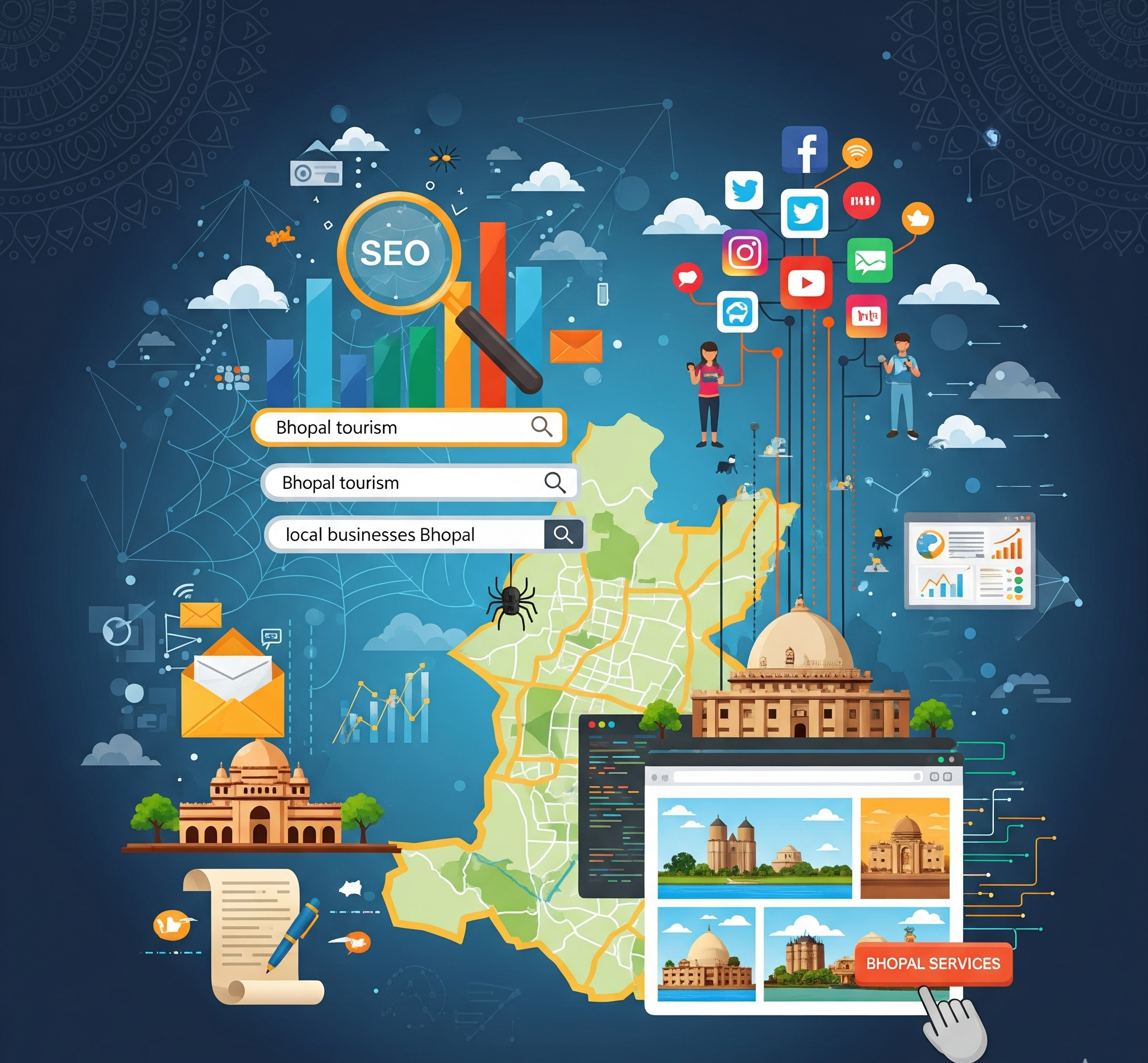
Today, there is no question that digital marketing is not a choice but rather a must. Whether you run a small local shop or a big national company, your online presence is crucial.
The top digital marketing agencies in Bhopal apply a combination of tactics including seo, social media marketing, web development and paid advertising in order to greatly grow your business.
In this post, we highlight 7 key strategies top digital agencies implement to drive traffic, gain leads and sales for local businesses in Bhopal.

Importance of Digital Marketing for in Bhopal Businesses
Bhopal is an evolving market and it’s completely dependent on internet surfing to let people make purchases. Whether it’s restaurant meals or real estate, customers go online for information before making purchases.
A good marketing agency in Bhopal can assist your business:
SEO and Social Media Optimization for more online visibility
Generate leads with targeted PPC ads Create qualified leads through PPC ads that are targeted to promote your firm for the services important to business owners.
Establish trust and authority through epic content
Personalize campaigns for a local market, so that your marketing is more relevant
Example:
A local restaurant making smart choices online can rank in “near me” searches, drive foot traffic and ramp up its online orders thanks to Google and Instagram ads.
Develop an Effective Digital Marketing Strategy
Every winning campaign begins with a detailed, actionable plan.
Your strategy should include:
Market research and competitor analysis
Knowing your audience and their needs
Selecting appropriate marketing channels (SEO, social media, PPC, etc.
Establishing Goals and KPIs to define success
Pro Tip:
Begin with organic marketing including SEO and social media. When you get the ball rolling, invest in some PPC advertising for quicker results.
Smart SEO with Latest Updates
SEO is the lifeblood of digital expansion. One of the best SEO companies in Bhopal has been working on following three factors.
On-page SEO: It relates to all factors on your own website which can be optimised for search engines like google, including content, meta tags and internal hyperlink building.
Off-page SEO: Generating quality backlinks and citations for local business
Technical SEO: Increasing speed, mobile responsiveness and site structure.
The ability of your site to evolve and avoid getting penalised is determined by its keep-it-fresh score, not the arbitrary date you published it.
Example Keyword Use:
“Our team stays up to date with the most recent SEO changes to help our clients rank and maintain their rankings over time.”
High-Performing Website Design & Development
Your website is essentially your digital shop front. Slow or poorly designed, potential customers will go elsewhere.
What A web design company in Bhopal does?
Mobile-friendly, responsive designs
Pages load in less than 3 seconds
SEO-friendly structure and clean coding
Clean and tidy navigation with strong CTA buttons
A web development company in Bhopal, on the other hand, makes sure your website is secure and scalable along with incorporated analytics to track well.
Internal Linking Tip:
Link this to your web development service page for stronger SEO.
Social Media Marketing That Engages
Social media isn’t just about posting images-it’s also a place to connect with your audience.
An effective social media marketing strategy consists of:
Interactive material such as reels, videos and infographics
Consistent posting schedules
Utilize local hashtags and trending topics.
Creating paid advertisements for targeted exposure
Example:
A Bhopal-based apparel brand saw sales take a 45% jump after posting Instagram ads and tied up with local influencers.
Focused PPC Campaigns for Immediate Effects
PPC advertising is all about getting immediate exposure and instant results when done right.
The top agencies use to advertise by PPC:
Google Ads for search-driven traffic
Facebook & Instagram Ads for local targeting
LinkedIn Ads for B2B businesses
Benefits of PPC:
Instant traffic and visibility
Better audience targeting
Easy tracking and measurable ROI
Internal Linking Tip:
For more details, link to your PPC service page.
Tactic 6 – Always Blog And Create Content Old but new, this takes people away.
Your content is what helps you build that trust and get established as an authority in your niche.
Top agencies focus on:
Blogs that highlight response to customer questions on a weekly basis
Local seo content for bhopal audiences. 2019 hsn code list city wise searchable pdf and excel file.
Educational resources to nurture leads
Example Blog Topics:
24 SEO Updates Every Business Owner Should Know
Why to Join Web Development Classes in Bhopal? Opportunities on Your Career”
Top Small Business Digital Marketing Trends
Follow Data to Analyze and Improve
Digital marketing is not a one-time job. You must monitor your progress and optimize incessantly.
You can do this through tools such as Google Analytics and Search Console:
Monitor traffic and conversions
Identify underperforming pages
Modify tactics according to the facts
Pro Tip:
Weekly review of analytics with small, steady changes.
FAQs
Q1. What would you need a digital marketing company in Bhopal?
Local agencies simply know the market, competition, how customers behave better and that gives you a definite edge.
Q2. How frequently should I be updating my SEO strategy?
No less than 4 times per year or after significant Google algorithm changes.
Q3. What is more effective: SEO or PPC?
SEO is for sustainable growth, PPC is providing instant results. A mix of both is ideal.
Q4. What are the best in digital marketing topics to study?
SEO, social, PPC, content and analytics.
Conclusion & Call to Action
Developing an effective internet presence is hard – it takes a lot of time, consistency and knowhow. With these seven strategies, your business can differentiate itself and grow at a faster pace than that of the competition.
Final Tip:
Collaborate with a reliable digital marketing agency in Bhopal to receive professional advice and measurable results.
Ready to grow your business?
Reach out to Orphic Solution now for a free SEO analysis and consultation.
In 2024, SEO (Search Engine Optimization) remains one of the most effective strategies to grow your online presence, drive organic traffic, and improve website rankings. Whether you’re a small business owner, a blogger, or managing a large e-commerce store, understanding and implementing SEO is vital to staying competitive in the digital landscape.
For beginners, diving into SEO might feel overwhelming, but with the right guidance and tools, you can create a strong foundation to build upon. In this comprehensive guide, we’ll cover 25 powerful tips using updated strategies, trends, and data to help you excel in your SEO journey.
Why is SEO Important in 2024?
Search engines are the gateway to the internet, and SEO helps you stand out in the crowded digital marketplace. With Google processing over 8.5 billion searches daily (as of 2024), ranking higher in search results can drive significant traffic and potential customers to your website.
Moreover, with the rise of AI-driven search features and voice search, optimizing your site ensures you stay ahead of technological changes.
25 Powerful SEO Tips for Beginners
1. Master Keyword Research
Keyword research forms the backbone of any SEO strategy. Use updated tools like Ahrefs, SEMrush, and Google Keyword Planner to identify trending keywords with low competition. Focus on long-tail keywords like “how to improve website ranking for beginners” as they often have higher conversion rates.
2. Optimize Your Content for User Intent
Understanding user intent in 2024 is more critical than ever. Users search for specific answers, and your content must deliver value. Address informational, navigational, and transactional queries to ensure your content ranks for diverse search intents.
3. Leverage SEO-Friendly Content Writing Techniques
When creating content, prioritize readability, structure, and engagement. Use short paragraphs, bullet points, and subheadings. Include primary keywords like “SEO tips for beginners” naturally, without overstuffing.
4. Focus on Mobile Optimization
In 2024, over 58% of global web traffic comes from mobile devices. Google’s mobile-first indexing means your site must be mobile-friendly. Tools like Google Mobile-Friendly Test can help you evaluate and optimize your site for smartphones and tablets.
5. Improve Website Speed
Website speed directly affects user experience and rankings. Pages that load in less than 2 seconds have higher engagement rates. Use tools like GTmetrix or Google PageSpeed Insights to identify bottlenecks and implement fixes, such as optimizing images or enabling browser caching.
6. Build High-Quality Backlinks
Backlinks remain a significant ranking factor in 2024. Focus on quality rather than quantity. Reach out to authoritative websites for guest blogging opportunities and participate in forums to build backlinks for SEO that drive credibility.
7. Conduct Regular SEO Audits
Run an SEO audit guide every quarter to analyze your site’s performance. Tools like Screaming Frog can help identify issues such as broken links, duplicate content, or missing meta tags.
8. Prioritize Local SEO Strategies
If you operate a local business, optimizing for local SEO for beginners is essential. Create or update your Google My Business profile, include location-specific keywords, and encourage customer reviews.
9. Optimize for Voice Search
With the increasing use of smart assistants like Alexa and Siri, voice search queries are becoming more conversational. Use phrases and long-tail keywords like “best pizza places near me” to cater to this growing trend.
10. Avoid Common SEO Mistakes
Common mistakes such as keyword stuffing, ignoring analytics, and poor mobile optimization can hurt your rankings. Keep track of what works and avoid practices flagged as outdated or manipulative.
Advanced SEO Techniques for 2024
11. Use Structured Data
Structured data (schema markup) helps search engines understand your content better. It can enhance your results with rich snippets like star ratings, images, and FAQs.
12. Create Video Content
Video is dominating in 2024, with platforms like YouTube and TikTok driving significant traffic. Optimize your videos with relevant tags, descriptions, and transcriptions.
13. Focus on User Experience (UX)
Google’s Core Web Vitals now play a significant role in rankings. Ensure fast load times, responsive design, and intuitive navigation to provide an exceptional user experience.
14. Develop a Robust Internal Linking Strategy
Internal links connect your pages and keep visitors engaged. A strong linking structure also helps search engines crawl your site effectively.
15. Utilize AI-Powered SEO Tools
AI tools like ChatGPT and Jasper are revolutionizing content creation and optimization. Use them to generate ideas, improve readability, and enhance keyword usage.
SEO Tools for Beginners
16. Keyword Research Tools
Start with tools like Ubersuggest or Moz to find relevant keywords for your niche.
17. SEO Plugins
If you’re using WordPress, install plugins like Yoast SEO or Rank Math to simplify technical optimization.
18. Analytics Tools
Google Analytics and Search Console provide detailed insights into your traffic and ranking performance.
19. Rank Tracking Tools
Monitor your keyword positions with tools like SE Ranking or SERPWatcher to measure progress.
20. Backlink Analysis Tools
Use platforms like Majestic or Ahrefs to analyze and strengthen your backlink profile.
Emerging Trends in SEO for 2024
21. AI-Driven Personalization
Search engines now emphasize personalized results. Tailor your content to align with user behavior for higher engagement.
22. Optimize for Zero-Click Searches
Focus on featured snippets, FAQs, and other content formats that answer user queries directly on the SERPs.
23. Multilingual SEO
If you target a global audience, implement multilingual SEO strategies to cater to different languages and regions.
24. Content Refresh
Regularly update old content with current information and trends to maintain relevance and rankings.
25. Invest in Localized Content
Localized strategies for small businesses include publishing location-specific blogs and using geo-targeted ads.
Conclusion: Your SEO Journey Starts Here
SEO in 2024 is dynamic, driven by technological advancements and evolving user behavior. By following these 25 powerful tips, you’ll be equipped with the tools and knowledge to grow your website traffic, enhance user experience, and achieve higher rankings.
Remember, SEO is a long-term commitment. With consistent effort and adaptation to new trends, your website can become a significant player in its niche.

How to Earn Money with Digital Marketing 2026: A Complete Guide

Digital Marketing Career Roadmap: Your Complete Step-by-Step Guide (2026)

Best Digital Marketing Institute in India: The Only Complete Guide You Will Ever Need

Google’s New Algorithm Updates 2024: Impacts on Local SEO and Content Quality

Data-Driven Decision Making: Leveraging Analytics for Marketing Success
