Digital Marketing Tips
What is Digital Marketing? Complete Beginner Guide (2026)

What is Digital Marketing? Understanding the Basics
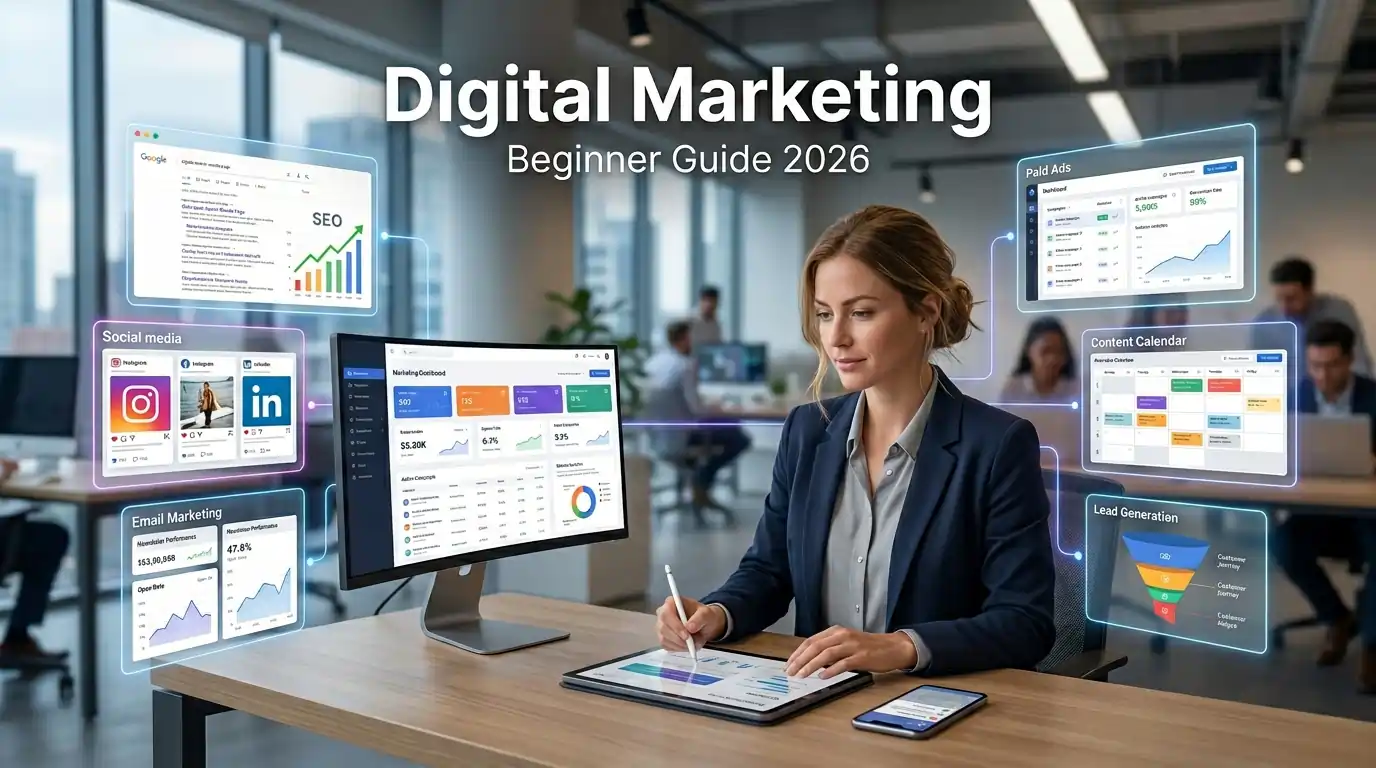
If you have ever searched for something on Google, seen an ad on Instagram, or received a promotional email from a brand – you have already experienced digital marketing. But what is digital marketing, exactly? And why is everyone talking about it?
Let’s break it down in the simplest way possible.
Digital Marketing is the process of promoting products, services, or brands using the internet and digital devices. This includes everything from showing ads on Google and Facebook, to writing blog posts, sending emails, making YouTube videos, and even posting on Instagram. Basically, anything that helps a business connect with its customers online is a part of digital marketing.
The beauty of digital marketing is that it works for everyone – whether you run a small tea shop in your city or you manage a large e-commerce company. The internet gives every business an equal chance to reach the right people.
Digital Marketing Meaning in Simple Words
The digital marketing meaning is simple – it is marketing done through digital channels. These channels include search engines like Google, social media platforms like Instagram and Facebook, email, websites, YouTube, and mobile apps.
Think of it this way. Traditional marketing is when you put up a banner on the road or advertise in a newspaper. Digital marketing is when you do the same thing, but online. The difference is – with digital marketing, you can reach thousands of people with a much smaller budget, and you can actually track who saw your ad and who clicked on it.
In short, what is digital marketing in simple words? It is using the internet to find customers, talk to them, and convince them to buy your product or use your service.
Digital Marketing vs Traditional Marketing – Key Differences
A lot of people ask – how is digital marketing different from traditional marketing? The table below gives you a clear, side-by-side picture of exactly where the two approaches differ and why more and more businesses are shifting their marketing budgets to the digital side.
| Factor | Traditional Marketing | Digital Marketing |
| Reach | Limited to local / regional area | Global – reach anyone, anywhere on the internet |
| Cost | High – TV, print, outdoor ads are expensive | Low to medium – even small budgets show results |
| Tracking | Very difficult – hard to measure real results | Easy – every click, view, and lead is trackable |
| Targeting | Broad – message goes to everyone | Precise – reach only people who want your product |
| Flexibility | Fixed – cannot change ad once published | Flexible – edit, pause, or update campaigns anytime |
| Speed | Slow – campaigns take weeks to plan and launch | Fast – ads can go live within hours |
| Engagement | One-way – audience cannot respond directly | Two-way – people can like, comment, message, and share |
Looking at this table, it is easy to understand why digital marketing has become the preferred choice for businesses of all sizes. It is not just cheaper – it is smarter, faster, and far more measurable than anything traditional marketing can offer.
How Digital Marketing Works Step by Step
One of the most common questions people have is – how digital marketing works, exactly? Is it just posting on social media? Or is there more to it?
The truth is, digital marketing is a system that works step by step. When done right, it brings the right people to your business at the right time and turns them into paying customers.
The Digital Marketing Process Explained Simply
Here is how digital marketing works step by step in real life:
1. Step 1 – Understand your audience: First, you figure out who your ideal customer is. What do they search for? What problems do they have? Where do they spend time online?
2. Step 2 – Create a strong online presence: This means having a good website, active social media profiles, and useful content that helps your audience.
3. Step 3 – Drive traffic: You bring people to your website or social media pages through SEO, paid ads, social media posts, or emails.
4. Step 4 – Engage and build trust: Once people visit, you give them helpful content, answer their questions, and show them why your product or service is the best choice.
5. Step 5 – Convert visitors into customers: Using calls-to-action, landing pages, or offers, you turn interested visitors into actual buyers.
6. Step 6 – Retain and grow: After someone buys, you keep them happy using email follow-ups, loyalty offers, and consistent engagement.
What is Digital Marketing for Beginners – A Simple Breakdown
What is digital marketing for beginners? It is simply learning how to use digital tools to grow a business. As a beginner, you do not need to learn everything at once. You can start with one channel – maybe SEO or social media – understand how it works, and gradually build your skills.
The internet marketing basics are not as complicated as they seem. The core idea is always the same – find your audience, give them value, and build a relationship with them.
Types of Digital Marketing Every Beginner Must Know
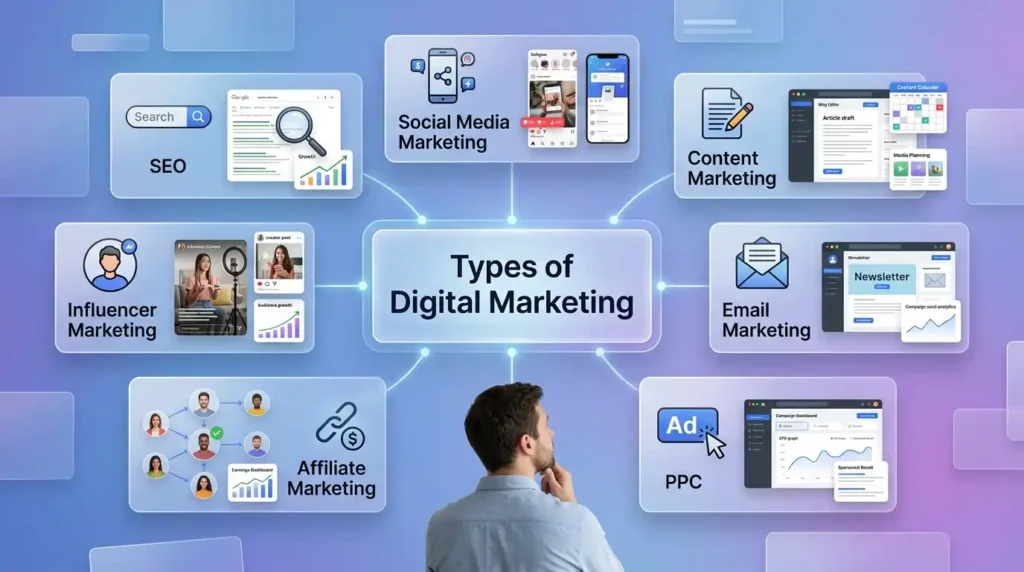
Now that you know what digital marketing is and how it works, let’s talk about the different types of digital marketing. These are the main channels that businesses use to reach their customers online. Each type works differently, serves a different purpose, and is best suited for different business goals.
1. Search Engine Optimization (SEO)
SEO is the process of making your website appear on the first page of Google when someone searches for something related to your business. For example, if you run a bakery in Delhi and someone searches ‘best bakery in Delhi’, SEO helps your website show up in those results – for free. SEO takes time, but the results are long-lasting. It is one of the most powerful types of digital marketing for any business that wants steady, organic growth.
2. Social Media Marketing (SMM)
Social Media Marketing means using platforms like Instagram, Facebook, LinkedIn, and YouTube to promote your business. This includes posting content, running paid ads, going live, and engaging with your followers. Which social media platform should you use? That depends on where your audience spends their time. For a fashion brand, Instagram works great. For a B2B company, LinkedIn is more useful.
Also Read – Industry News and TrendsThe Power of Social Media Marketing: A Guide for Businesses
3. Content Marketing
Content marketing is about creating useful, valuable content – like blog posts, videos, podcasts, and infographics – that attracts people to your brand. Instead of directly saying ‘buy my product’, you help your audience solve a problem, and they come to trust you. This guide you are reading right now is a perfect example of content marketing in action.
4. Email Marketing
Email marketing is when you send targeted emails to people who have subscribed to your list. These emails can include offers, product updates, helpful tips, or newsletters. Email marketing is one of the highest ROI types of digital marketing because you are reaching people who already showed interest in your brand.
5. Pay-Per-Click Advertising (PPC)
PPC means you pay every time someone clicks on your ad. Google Ads and Facebook Ads are the most popular PPC platforms. With PPC, your ad shows up immediately – unlike SEO, which takes time. It is great when you want quick results or want to promote a specific offer.
6. Affiliate Marketing
Affiliate marketing is when someone promotes your product and earns a commission for every sale they bring. A blogger writes a review, includes a link, and earns money every time a reader buys through that link. It is a win-win model for both the business and the affiliate.
7. Influencer Marketing
Influencer marketing is when brands collaborate with social media influencers – people who have a large and loyal following – to promote their products. When the right influencer talks about your product, their audience trusts the recommendation, which leads to more sales and brand awareness quickly.
Now that you know all 7 types, here is a quick reference table that shows which type is best suited for your goals, how much it typically costs, and how soon you can expect to see results.
| Type | Best For | Cost Level | Time to Results |
| SEO | Long-term organic traffic and brand visibility | Low | 3 to 6 months |
| Social Media (SMM) | Brand awareness and audience engagement | Low-Med | 1 to 3 months |
| Content Marketing | Trust building and attracting inbound leads | Low | 3 to 12 months |
| Email Marketing | Nurturing leads and retaining existing customers | Low | Immediate |
| Pay-Per-Click (PPC) | Quick leads and sales for any business | Med-High | Immediate |
| Affiliate Marketing | Scaling sales with zero upfront ad spend | Low | 1 to 3 months |
| Influencer Marketing | Reaching new audiences through trusted voices | Varies | 1 to 4 weeks |
Not sure which type of digital marketing is right for your business? At Orphic Solution, we help you pick the right channels based on your goals, budget, and target audience – and then execute them for you. Get in touch for a free strategy consultation.
Also Read – 10 Quick SEO Tips to Boost Your Website Ranking
Digital Marketing Examples for Beginners (Real-World Cases)
Sometimes the best way to understand something is to see it in action. Here are some real digital marketing examples for beginners that show how businesses use these strategies every day.
Example 1: How a Small Business Uses SEO to Get Customers
Imagine you run a local plumbing service in Bhopal. Someone’s tap breaks and they search ‘plumber near me’ on Google. If your website is SEO-optimized, your business shows up at the top, and that person calls you. That is SEO doing its job – no ad budget needed, just good content and the right keywords.
Example 2: How Brands Use Social Media Marketing to Go Viral
A clothing brand posts a funny reel on Instagram showing how to style one shirt in five different ways. People share it, comment on it, and tag their friends. Within days, thousands of people know about that brand – without spending a single rupee on ads. This is the power of organic social media marketing.
Example 3: How Email Campaigns Drive Sales
An online bookstore notices that a customer added books to the cart but did not buy. They send a friendly email – ‘Hey, you forgot something!’ – with a 10% discount offer. The customer comes back and completes the purchase. This is called a cart abandonment email, and it is one of the most effective email marketing strategies in any online marketing guide.
Why Digital Marketing is Important in Today’s World
You might wonder – why is digital marketing important? Can’t a business grow without it? The honest answer is – not easily. Today, more than 5 billion people are active internet users. Your customers are online – they are searching, scrolling, and shopping every day. If your business is not visible online, you are missing a massive opportunity.
Top 7 Digital Marketing Benefits for Businesses and Individuals
- Reach a global audience without a huge budget – a small business can compete with big brands online.
- Target the exact right people – show your ad only to people who are interested in what you sell.
- Track every result in real time – know exactly how many people saw your ad, clicked on it, and bought from you.
- Cost-effective – even with a small budget, digital marketing can deliver strong results.
- Build trust and brand awareness – regular content and social media presence makes people recognize and trust your brand.
- Available 24/7 – your website and ads work even when you are sleeping.
- Easy to scale – what works can be multiplied quickly without huge extra costs.
Why Every Business Needs an Online Marketing Strategy
Having a proper online marketing strategy is no longer optional – it is necessary. Whether you are a freelancer, a startup, a local business, or a large corporation, digital marketing gives you the tools to grow faster and smarter. Without a clear digital strategy, you are spending money and time without direction.
Also Read – Top 10 SEO Mistakes That Could Be Hurting Your Website
Real Business Benefits of Digital Marketing – Why Smart Businesses Are Investing in It Now
If you are a business owner and you are still wondering whether digital marketing is worth the investment – this section is for you.
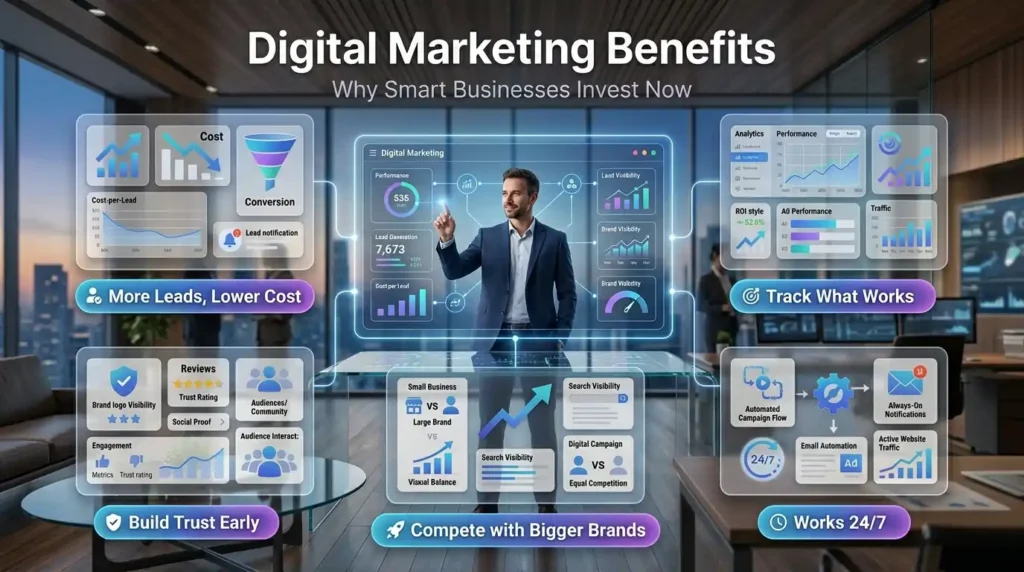
Let’s talk about the real, measurable benefits of digital marketing that directly impact your revenue, your brand, and your customer base. These are not just theoretical advantages. These are the reasons why businesses across India – from startups in Bhopal to large brands in Mumbai – are shifting their budgets from traditional marketing to digital.
1. You Get More Leads at a Lower Cost
One of the biggest benefits of digital marketing is that it brings you qualified leads – people who are already looking for what you offer – at a fraction of the cost of traditional advertising.
Think about it. A newspaper ad in Bhopal costs thousands of rupees and reaches everyone – including people who will never buy from you. But a Google Ad targeting ‘digital marketing company in Bhopal’ reaches only the people who are actively searching for that service right now. That is the difference between shouting in a crowd and having a direct conversation with the right person.
Businesses that use digital marketing for lead generation report up to 3x more leads compared to businesses that rely only on traditional marketing – and at a significantly lower cost per lead.
2. You Can See Exactly What is Working and What is Not
With traditional marketing, you put money into an ad and hope it works. With digital marketing, you know exactly what is working – in real time.
You can see how many people visited your website, where they came from, how long they stayed, which page made them leave, and which page convinced them to contact you. This level of insight is something traditional marketing can never give you. And when you know what works, you stop wasting money on what does not.
3. You Build a Brand That People Trust – Even Before They Buy
Why do people choose one business over another when both offer similar services? Trust. And digital marketing is the most powerful way to build that trust consistently.
When your business regularly appears in Google search results, publishes helpful content, stays active on social media, and collects positive reviews – people start recognizing you as an authority. They may not contact you the first time they see you. But by the third or fourth time, you are the first name they think of when they are ready to buy.
4. You Stay Competitive – Even Against Much Bigger Brands
One of the most powerful benefits of digital marketing for small and medium businesses is that it levels the playing field. A well-optimized website, a strong local SEO strategy, and smart social media content can help a small business rank above a big competitor on Google. The internet rewards the business that gives the best, most relevant answer to the customer’s question – not the biggest budget.
5. Digital Marketing Works While You Sleep
Your website is open 24 hours a day. Your Google Ads run at midnight. Your email sequence sends automatically. Your blog post from six months ago is still bringing visitors to your website today. This is what makes digital marketing one of the smartest investments a business can make – it builds momentum over time and generates leads around the clock.
Want to know exactly how digital marketing can generate leads and grow revenue for your specific business? Talk to an expert today. A free consultation can show you where your biggest opportunities are hiding.
Common Digital Marketing Challenges – And How to Overcome Them
Digital marketing is powerful – but it is not without its challenges. If you have tried running ads or posting on social media and felt like nothing was working, you are not alone. Most businesses face the same struggles when they start. The good news? Every challenge in digital marketing has a solution.
Challenge 1: Not Knowing Where to Start
This is the most common challenge for beginners and small business owners. There are so many channels – SEO, social media, email, PPC, content marketing – that it is hard to know which one to focus on first.
How to overcome it: Start with one channel based on where your customers are most active. If your customers search on Google for services like yours, start with SEO. If they are on Instagram, start with social media. Do not try to do everything at once. Master one channel, get results, and then expand.
Challenge 2: Getting Traffic But No Leads
A lot of businesses have decent website traffic but very few inquiries or sales. Why? Because getting people to visit your website is only half the job. The other half is converting those visitors into leads.
How to overcome it: Your website needs clear calls-to-action, fast loading speed, a mobile-friendly design, and landing pages that are built specifically to convert. If your website is not designed to capture leads, even the best SEO in the world will not help your business grow.
Challenge 3: Inconsistent Results from Paid Ads
Many business owners try Google Ads or Facebook Ads, spend money, and get little to no results. This usually happens because the targeting is wrong, the ad copy is weak, or the landing page does not match what the ad promised.
How to overcome it: Successful PPC campaigns require proper keyword research, compelling ad copy, smart audience targeting, and a well-designed landing page. Without all four working together, your ad budget is essentially wasted. This is why businesses see dramatically better results when they work with experienced digital marketing professionals.
Challenge 4: Keeping Up with Constant Changes
Google updates its algorithm hundreds of times a year. Social media platforms change their content policies regularly. Digital marketing is a fast-moving field, and it can be exhausting to keep up. How to overcome it: Focus on the fundamentals – create genuinely helpful content, build a fast and user-friendly website, and engage honestly with your audience. For the technical updates, partnering with a reliable digital marketing agency means you are always ahead of the changes without having to track them yourself.
Challenge 5: Measuring ROI Correctly
One of the trickiest parts of digital marketing is figuring out what is actually working. Many businesses look at vanity metrics – likes, followers, impressions – and miss the real numbers that matter, like cost per lead, conversion rate, and customer acquisition cost.
How to overcome it: Set up Google Analytics, track your conversions, and define what a result looks like for your business before you start any campaign. A good digital marketing agency will give you clear reports that show exactly how your investment is performing – not just traffic numbers, but actual business results.
Facing any of these digital marketing challenges right now? You do not have to figure it out alone. Get in touch with Orphic Solution for a free consultation and let our experts build a strategy that actually works for your business.
Digital Marketing Opportunities You Should Not Miss in 2026
If there is one thing that makes digital marketing exciting, it is the sheer number of opportunities that exist right now – opportunities that were not available even five years ago. Whether you are a business owner looking to grow, or someone who wants to build a career, the digital marketing landscape in 2026 is full of doors waiting to be opened.
Opportunity 1: Local SEO – The Goldmine for Small Businesses
Thousands of people search every day for services near them – ‘digital marketing company in Bhopal’, ‘best restaurant near me’, ‘plumber in my area’. This is called local search, and if your business is not optimized for it, you are invisible to these potential customers.
Local SEO is one of the highest-ROI opportunities available to small and medium businesses right now. Why? Because local searches have very high commercial intent – when someone searches ‘digital marketing agency in Bhopal’, they are not doing research. They are ready to hire. Most small businesses in smaller cities are not doing proper local SEO – which means less competition and faster results for the ones who start now.
Opportunity 2: Short-Form Video Content (Reels and YouTube Shorts)
Instagram Reels and YouTube Shorts are getting enormous reach right now – far more than regular posts or longer videos. Businesses that use short-form video to educate, entertain, or show behind-the-scenes content are building audiences at a speed that was impossible just a few years ago. And the best part – short-form videos cost very little to produce and can reach lakhs of people organically.
Opportunity 3: AI-Powered Marketing Tools
Artificial Intelligence is changing how digital marketing works – and businesses that learn to use AI tools smartly are getting ahead of their competition. AI tools can now help you write content faster, analyze data better, automate customer communication, personalize email campaigns, and optimize ad bids in real time. Businesses that combine human expertise with AI tools are going to outperform those who ignore this shift.
Opportunity 4: Email Marketing with Personalization
Email marketing has one of the highest ROI of any digital marketing channel. What has changed is that generic mass emails no longer work. What does work is personalized, segmented email marketing that sends the right message to the right person at the right time. This is a major opportunity for businesses that have an existing customer list or lead database – with the right email strategy, that list can become a consistent source of revenue.
Opportunity 5: Building Authority Through Content
In 2026, one of the biggest opportunities in digital marketing is becoming the most trusted and helpful voice in your industry or niche. Businesses that consistently produce high-quality content – blogs, videos, podcasts, guides – are building digital assets that bring them leads and customers for years. This is especially powerful for service businesses like digital marketing agencies, law firms, healthcare providers, and financial consultants.
Opportunity 6: Performance Marketing for E-Commerce
For businesses selling products online, the combination of Google Shopping Ads, Meta Ads with smart targeting, and retargeting campaigns is creating extraordinary results. E-commerce businesses that invest in professional performance marketing now will gain a significant advantage over competitors who are still running basic, unoptimized ads without a proper funnel strategy.
Ready to Turn These Opportunities Into Real Business Growth?
At Orphic Solution, we help businesses in Bhopal and across India take full advantage of digital marketing – from local SEO and social media to paid ads and content strategy. Whether you are just starting out or looking to scale, we build strategies that bring real leads and real results.
Get a FREE Digital Marketing Consultation Today
Call: 099937 72685 | Email: info@orphicsolution.com | orphicsolution.com
Digital Marketing Skills Required to Build a Career
If you are thinking about building a career in digital marketing, you might be asking – what digital marketing skills are required to get started? The good news is that most of these skills can be learned online, for free.
Technical Skills Every Digital Marketer Needs
- SEO basics – knowing how to optimize content and websites for Google.
- Google Analytics – understanding how to read website data and make decisions based on it.
- Social media management – knowing how to create, schedule, and analyze posts on different platforms.
- Google Ads and Meta Ads – running paid ad campaigns on Google and Facebook and Instagram.
- Email marketing tools – using platforms like Mailchimp or Klaviyo to send and track emails.
- Basic content writing – writing blogs, captions, and ad copy that connect with people.
Soft Skills That Make You a Successful Digital Marketer
- Curiosity and willingness to keep learning – digital marketing changes fast, so staying updated is important.
- Creativity – coming up with fresh ideas for content, campaigns, and problem-solving.
- Analytical thinking – being comfortable reading numbers and understanding what they mean.
- Communication – clearly explaining ideas to clients, teams, or your audience.
- Time management – handling multiple tasks like writing, posting, reporting, and strategy at once.
Is Digital Marketing Easy to Learn for Beginners?
This is one of the most searched questions by people who are just getting started – is digital marketing easy to learn? The honest answer is – it is not too hard, but it is not too easy either. It depends on how you approach it. If you try to learn everything at once, it can feel overwhelming. But if you take it one step at a time, it is very manageable.
Can Beginners Learn Digital Marketing with No Experience?
Absolutely yes. Can beginners learn digital marketing? Of course they can. You do not need a marketing degree or any prior experience to start. Thousands of people have built successful digital marketing careers starting from zero. What you do need is consistency, curiosity, and a willingness to practice.
How Long Does It Take to Learn Digital Marketing?
If you spend 1 to 2 hours daily learning and practicing, you can get a basic understanding of digital marketing in 3 to 6 months. To become job-ready or freelance-ready, it usually takes around 6 to 12 months of consistent effort. The key is to pick one area first, get good at it, and then expand your knowledge to other channels.
How to Start Digital Marketing as a Complete Beginner
Now comes the most exciting part of this beginner guide to digital marketing – actually getting started. Here is a simple, step-by-step roadmap that anyone can follow.
Step-by-Step Roadmap to Start Digital Marketing in 2026
- Step 1 – Learn the basics: Start with free resources like Google Digital Garage, HubSpot Academy, and YouTube channels dedicated to digital marketing.
- Step 2 – Choose one area to focus on: SEO, social media, content writing, or PPC – pick one to start.
- Step 3 – Build your own online presence: Start a blog, a YouTube channel, or an Instagram page and use it as your practice ground.
- Step 4 – Get certified: Platforms like Google, HubSpot, and Meta offer free certifications that look great on your resume or portfolio.
- Step 5 – Do real projects: Offer your services to a small local business for free or at a low cost. Real results build real credibility.
- Step 6 – Build a portfolio: Document your work – show what you did, what results you got, and what you learned.
- Step 7 – Stay updated: Follow digital marketing blogs, listen to podcasts, and join communities to stay current with industry changes.
Best Free Resources and Tools to Learn Digital Marketing
- Google Digital Garage – Free courses on SEO, analytics, and more.
- HubSpot Academy – Excellent certifications on inbound marketing, content, and email.
- Moz Blog and Ahrefs Blog – Fantastic for learning SEO deeply.
- Neil Patel’s website – Full of beginner-friendly guides on all digital marketing basics.
- YouTube – Channels like Neil Patel, Ahrefs, and Semrush are perfect for visual learners.
Also Read – 8 Proven Strategies for Effective Social Media Marketing
Frequently Asked Questions About Digital Marketing
What is digital marketing in simple words?
Digital marketing means promoting your business using the internet. It includes using Google, social media, email, and websites to find customers and grow your brand. It is simply marketing – done online.
How does digital marketing work?
Digital marketing works by identifying your target audience, creating content or ads that appeal to them, driving them to your website or page, and then converting them into customers using various strategies like SEO, ads, or email follow-ups.
What are the main types of digital marketing?
The main types of digital marketing include SEO, social media marketing, content marketing, email marketing, pay-per-click advertising, affiliate marketing, and influencer marketing.
What is digital marketing for beginners?
For beginners, digital marketing means learning how to use the internet to promote a business. You start with the basics – understanding your audience, creating content, and learning one channel at a time – and gradually build your skills.
Is digital marketing easy to learn?
Digital marketing is not too hard, but it requires consistent effort and practice. With the right resources and a step-by-step approach, most beginners can become competent within 6 to 12 months.
What digital marketing skills are required?
Key skills include SEO, content writing, social media management, paid advertising, email marketing, and data analysis using tools like Google Analytics. Soft skills like creativity, communication, and analytical thinking are equally important.
Conclusion: Your Digital Marketing Journey Starts Today
So, what is digital marketing? It is the most powerful way to grow any business in today’s connected world. From SEO and social media to email campaigns and paid ads – digital marketing gives you the tools to reach your ideal customer, build trust, and drive real results.
Whether you are a complete beginner trying to understand the basics, a business owner facing real digital marketing challenges, or someone ready to grab the opportunities that 2026 has to offer – the good news is that digital marketing is completely learnable and completely actionable.
You do not have to know everything on day one. Start small. Pick one skill, practice it every day, and keep building. And if you want expert help to skip the trial-and-error phase and go straight to results – that is exactly what Orphic Solution is here for.
Your journey into digital marketing starts with a single step. Take that step today.
Need Expert Digital Marketing Help for Your Business?
Orphic Solution – Best Digital Marketing Company in Bhopal
Call: 099937 72685 | Email: info@orphicsolution.com | orphicsolution.com
Do you want to earn money with digital marketing but don’t know where to start? You’re not alone. Thousands of students, working professionals, and business owners in India are asking the same question every single day. The good news is – this is one of the easiest fields to enter, even if you are a complete beginner.
In this complete guide, we will walk you through every single way you can earn money with digital marketing – from freelancing to building your own agency. Whether you want a side income or a full-time career, this blog has everything you need to get started today.
What is Digital Marketing and Why is It One of the Best Ways to Earn Money Online?
Digital marketing is the process of promoting products, services, or brands through the internet. It includes SEO, social media, content creation, email campaigns, paid ads, and much more. When you help businesses get more customers online, they pay you for that – and that is how you earn money with digital marketing.
India’s digital economy is growing at a massive pace. More than 900 million Indians use the internet today. Businesses – small and big – all need an online presence. They need someone who knows digital marketing income methods to help them grow. That person can be you.
The best part? You don’t need a college degree or a big investment to start. You just need the right skills and the willingness to learn. The digital marketing earning potential in India is massive and it keeps growing every year.
DID YOU KNOW? The Indian digital advertising market reached ₹49,251 crore in 2024 and is projected to reach ₹69,856 crore by 2026 (Dentsu e4m Report). This means the demand for skilled digital marketers is only going to increase. Right now is the best time to start.
Who Can Earn Money with Digital Marketing – Is It Really for Everyone?
Yes, digital marketing is truly for everyone. Here is who can benefit from learning how digital marketers earn money:
- Students (even 12th pass): You can start learning while studying and take up freelance projects on the side.
- Homemakers: Work from home at your own time and build a steady digital marketing income while managing your family.
- Job seekers: Use digital marketing skills to get better digital marketing online jobs with higher pay.
- Business owners: Market your own business online and save money on advertising.
- Working professionals: Start a digital marketing side hustle to build an extra income stream alongside your 9-to-5 job.
No matter your background, age, or qualification – if you are willing to learn and work consistently, you can absolutely earn money with digital marketing.
Also Read – What Is Social Media Marketing? A Complete Beginner’s Guide (2026)
How Many Ways Can You Earn Money from Digital Marketing? (Top Income Streams Explained)
There are multiple digital marketing income streams you can tap into. You don’t have to stick to just one. Many successful digital marketers combine 2 to 3 of these methods to build a strong, stable income. Let’s look at all of them one by one.
How Does Freelancing in Digital Marketing Help You Earn a Steady Income?
Freelancing is the most popular way to start earning from digital marketing. In this model, you offer services like SEO, social media management, or content writing to clients and charge them per project or per month. This is the backbone of digital marketing freelance income in India.
Platforms like Upwork, Fiverr, Freelancer, and Internshala are great places to find your first client. Here are some digital marketing freelancing tips to get started fast:
- Create a strong profile with your skills and a clear description
- Start with small projects to build reviews and credibility
- Offer one or two services only – don’t try to do everything at once
- Deliver work on time and ask for feedback from every client
- Slowly increase your rates as your portfolio grows
A beginner can earn ₹15,000 to ₹30,000 per month through digital marketing freelance earning methods. An experienced freelancer can earn ₹1 lakh or more every month.
What is Affiliate Marketing and How Can You Earn Passive Income from It?
Affiliate marketing means you promote someone else’s product and earn a commission every time someone buys through your link. It is one of the best sources of digital marketing passive income because once your content is live, it keeps earning for you – even while you sleep.
You can do affiliate marketing through a blog, YouTube channel, Instagram page, or WhatsApp group. Popular platforms for digital marketing monetization through affiliates include Amazon Associates, Flipkart Affiliate, ShareASale, and ClickBank.
Here’s how it works: You write a blog post or make a video reviewing a product. Your reader clicks your affiliate link and buys the product. You get 5% to 30% commission – this is the power of online marketing earnings through affiliates.
How Can You Start a Digital Marketing Agency to Build a Business Income?
Starting your own agency is one of the best ways to scale your digital marketing business income. Instead of working alone for one client, you build a team and handle multiple clients at once.
- You get clients who need digital marketing services
- You hire freelancers or build a small team to do the work
- You charge a monthly retainer (typically ₹10,000 to ₹1 lakh per client)
- Your profit is the difference between what you charge and what you pay your team
This model has the highest marketing business earnings potential. Agencies in Bhopal and Indore regularly earn ₹5 lakh to ₹25 lakh per month once they are well-established. Your digital marketing business income strategies should focus on getting your first 3 to 5 retainer clients before you think about scaling.
How Does Blogging and Content Marketing Generate Digital Marketing Income?
Blogging is a long-term but very powerful way to build digital marketing income ideas into reality. When you write helpful content on a topic you know well, Google starts ranking your articles. Once people visit your blog, you can earn money through:
- Google AdSense (ads on your blog)
- Sponsored blog posts
- Affiliate links inside your content
- Selling digital products or courses
A blog that gets 50,000+ visitors per month can easily generate ₹50,000 to ₹2 lakh in online marketing earnings every month. It takes time, but it is one of the most stable income sources.
Where Can You Find Digital Marketing Online Jobs and Remote Work Opportunities?
If you want a stable salary with growth potential, digital marketing online jobs are a great option. Many companies – both Indian and international – hire full-time and part-time digital marketers remotely.
- LinkedIn – best for corporate and agency jobs
- Naukri.com – India’s largest job portal for marketing roles
- Indeed – good for both Indian and international jobs
- Internshala – great for freshers and students
- AngelList – best for startup jobs
The average salary for a fresher in a digital marketing earning methods based job is ₹15,000 to ₹25,000 per month. With 2 to 3 years of experience, this can jump to ₹50,000 to ₹80,000 per month or more.
How to Create and Sell Digital Marketing Courses to Earn Money Online?
If you are good at teaching, you can earn money with digital marketing by creating and selling online courses. Platforms like Udemy, Teachable, and even YouTube make it easy to reach thousands of students.
This is a powerful form of digital marketing monetization guide because a course you create once can be sold hundreds of times. Your digital marketing income streams multiply when you combine courses with a YouTube channel or Instagram page.
Many Indian digital marketing educators earn ₹2 lakh to ₹10 lakh per month just from course sales. You don’t need a big setup – a phone, good lighting, and clear knowledge is enough to get started.
What is Social Media Management and How Much Can You Earn from It?
Social media management means handling Instagram, Facebook, or LinkedIn accounts for businesses. You create posts, write captions, reply to comments, and run ads. This is one of the most in-demand skills in the digital marketing earning potential space right now.
A social media manager typically handles 3 to 5 clients at a time. Each client pays ₹8,000 to ₹25,000 per month. So your total digital marketing freelance income can easily reach ₹40,000 to ₹1 lakh per month from social media management alone. This is one of the fastest-growing sources of online marketing earnings in India today.
How Can Email Marketing Help You Build a Steady Digital Marketing Income?
Email marketing is one of the most underrated ways to earn money with digital marketing. It means sending targeted emails to a list of subscribers to promote products, services, or offers. Businesses love email marketing because every ₹1 spent on it returns ₹36 on average – making it the highest ROI channel in all of digital marketing.
As a digital marketer, you can offer email marketing as a standalone service. Here is what this service includes:
- Building and managing email lists for clients
- Writing email copy (subject lines, body, call to action)
- Setting up automated email sequences using tools like Mailchimp, ConvertKit, or Klaviyo
- Tracking open rates, click rates, and conversions
An email marketing specialist can charge ₹10,000 to ₹40,000 per client per month. This makes it a strong addition to your digital marketing income methods. Once you learn email automation, a lot of this work runs on auto-pilot – creating a true source of digital marketing passive income.
What is Lead Generation and How Does It Help You Earn Big?
Lead generation means finding potential customers for a business and delivering their contact details. It is one of the highest-paying digital marketing income streams because businesses – especially in real estate, education, and finance – pay very well for quality leads.
Here is how lead generation works as a service:
- You run Facebook Ads or Google Ads targeted to a specific audience
- Interested users fill out a form with their name, phone, and email
- You send those leads to your client
- You charge per lead (₹50 to ₹500 per lead) or a monthly retainer
A real estate client can pay ₹20,000 to ₹80,000 per month for consistent leads. This is one of the fastest ways to build strong marketing business earnings. Many digital marketers in India earn ₹50,000 to ₹2 lakh per month from lead generation services alone – making it one of the best digital marketing earning methods for those who know paid advertising.
DID YOU KNOW? India has over 500 million active social media users. Every business – from a local restaurant to a national brand – needs help managing their social media presence. This creates massive demand for social media managers across every city in India.
Also Read – Digital Marketing Skills Required: Complete Roadmap to Become a Digital Marketing Expert in 2026
When Should You Start Earning from Digital Marketing – What is the Right Time?
The answer is simple – NOW. There is no perfect time to start. But if you want a realistic timeline, here is what a beginner’s journey looks like:
| Month | What You Should Do | Expected Outcome |
| Month 1 – 2 | Learn basics of SEO, social media, and content marketing | Build foundation knowledge |
| Month 3 – 4 | Create sample projects, practice on your own profiles | Build a portfolio |
| Month 5 – 6 | Get first 1-2 freelance clients or apply for jobs | Start earning ₹10,000 – ₹25,000/month |
| Month 7 – 12 | Scale up clients, learn paid ads and analytics | Earn ₹30,000 – ₹80,000/month |
| Year 2+ | Start agency or build passive income | Earn ₹1 lakh+ per month |
The best digital marketing side hustle ideas to start with are social media management and content writing – both require minimal investment and can start generating digital marketing earning potential within 60 to 90 days of learning.
Ready to start your digital marketing journey? Contact Orphic Solution today and explore our digital marketing training programs in Bhopal!
How Long Does It Actually Take to Start Earning from Digital Marketing?
This is one of the most common questions beginners ask. The honest answer is – it depends on how much time you put in every day. But here is a realistic breakdown that most students and professionals experience when they start working to earn money with digital marketing:
| Time Invested Daily | Time to First Earning | Expected First Month Income |
| 1 – 2 hours/day | 4 to 6 months | ₹5,000 – ₹15,000 |
| 3 – 4 hours/day | 2 to 3 months | ₹15,000 – ₹30,000 |
| 5 – 6 hours/day (full focus) | 45 to 60 days | ₹25,000 – ₹50,000 |
| Full time (8+ hours) | 30 days | ₹30,000 – ₹60,000+ |
Remember – these are real numbers based on what students across India achieve when they stay consistent. The key factor is not just how much you learn, but how quickly you apply your knowledge and start talking to real clients. Your digital marketing earning potential grows much faster when you take action alongside learning.
Most people who focus on one skill – for example, SEO or social media management – and actively seek clients can start their digital marketing freelance income within 30 to 45 days of completing a good training course.
What Skills Do You Need to Earn Money with Digital Marketing in 2025?
To understand how to earn money with digital marketing, you first need to know which skills are in demand. You don’t need to master all of them – picking one or two and going deep is more effective than learning everything at a surface level.
| Skill | What It Involves | Monthly Earning Potential |
| SEO (Search Engine Optimization) | Rank websites on Google | ₹20,000 – ₹80,000 |
| Social Media Marketing | Manage and grow brand pages | ₹15,000 – ₹60,000 |
| Content Writing | Write blogs, ads, web copy | ₹12,000 – ₹50,000 |
| Pay-Per-Click (PPC) | Run Google and Meta Ads | ₹25,000 – ₹1,00,000 |
| Email Marketing | Build and run email campaigns | ₹15,000 – ₹50,000 |
| Video Marketing | Create and edit marketing videos | ₹20,000 – ₹70,000 |
| Analytics & Data | Track and improve campaigns | ₹25,000 – ₹90,000 |
The way digital marketers earn money depends heavily on which skill they specialize in. PPC and SEO tend to have the highest digital marketing income methods because businesses see direct ROI from these services and are willing to pay well.
Also Read – What is SEO? A Complete Beginner’s Guide to Search Engine Optimization (2026)
How Can You Use AI Tools to Earn More from Digital Marketing in 2025?
Artificial intelligence has completely changed how digital marketers work. In 2025, the digital marketers who use AI tools smartly are earning 2x to 3x more than those who don’t. Using AI is not cheating – it is smart working. And if you want to earn money with digital marketing faster, learning these tools is a must.
Here are the top AI tools that are helping digital marketers increase their digital marketing income methods and serve more clients in less time:
| AI Tool | What It Does | Time Saved Per Day |
| ChatGPT / Claude | Write blog posts, ad copy, email content | 2 to 4 hours |
| Canva AI | Create social media graphics and presentations | 1 to 2 hours |
| Jasper AI | Generate marketing content at scale | 2 to 3 hours |
| SurferSEO | Optimize blog content for Google ranking | 1 to 2 hours |
| AdCreative.ai | Create high-converting ad visuals automatically | 1 hour |
| Midjourney | Generate AI images for content and ads | 30 min to 1 hour |
When you use AI tools, you can handle 3 to 4 clients at the same time where earlier you could only handle 1 to 2. This directly multiplies your online marketing earnings. For example, a content writer who used to write 3 blogs per day can now write 8 to 10 with AI assistance – that means more clients, more projects, and more digital marketing freelance income.
More importantly, clients today expect their digital marketers to be AI-savvy. Knowing these tools gives you a competitive edge and helps you justify higher rates – which directly boosts your overall digital marketing earning potential.
Where to Learn Digital Marketing for Free or at Low Cost to Start Earning Faster?
You don’t need to spend a lot of money to learn digital marketing. Here are some great resources to master digital marketing freelancing tips and skills without breaking the bank:
- Google Digital Garage – Free certified course on digital marketing basics
- HubSpot Academy – Free certifications in content marketing, email, and inbound marketing
- Meta Blueprint – Free training on Facebook and Instagram ads
- YouTube – Thousands of free tutorials in Hindi and English
- Coursera and Udemy – Paid but very affordable structured courses
If you want hands-on training with real projects and placement support, you can also join a local digital marketing institute. Orphic Solution in Bhopal offers practical training where you learn live project management, SEO, SMM, and much more. Students who complete this training are ready to take up digital marketing online jobs and freelance work immediately.
Which Digital Marketing Certifications Can Help You Earn More Money?
A certification is proof that you know what you are doing. When clients or employers see that you have a recognized certificate, they trust you more – and trust translates directly into higher income. This is a key part of how digital marketers earn money at premium rates.
Here are the most valuable free certifications you should get to boost your digital marketing earning potential:
| Certification | Platform | Cost | Value |
| Google Digital Marketing Certificate | Google Digital Garage | Free | High – recognized globally |
| Google Ads Certification | Google Skillshop | Free | Very High – for PPC jobs |
| Meta Social Media Marketing | Meta Blueprint | Free | High – for SMM freelancing |
| HubSpot Content Marketing | HubSpot Academy | Free | High – for content roles |
| HubSpot Email Marketing | HubSpot Academy | Free | High – for email marketing |
| SEMrush SEO Certification | SEMrush Academy | Free | Very High – for SEO jobs |
Having 3 to 4 of these certifications on your LinkedIn profile makes a huge difference when you are applying for digital marketing online jobs or pitching to new freelance clients. Many companies in India specifically filter candidates by certifications. These are free to get, take only a few hours each, and can add ₹5,000 to ₹15,000 to your monthly salary or freelance rate. That is a direct improvement in your digital marketing income streams.
Also Read – How to Become a Social Media Manager
How Much Can You Really Earn with Digital Marketing in India? (Realistic Income Breakdown)
Let’s be real and honest about the digital marketing earning potential in India. The numbers below are based on real market data and actual earnings reported by professionals.
| Profile | Experience | Monthly Income Range |
| Fresher (Job) | 0 – 1 year | ₹12,000 – ₹25,000 |
| Mid-level (Job) | 2 – 4 years | ₹35,000 – ₹80,000 |
| Senior Manager (Job) | 5+ years | ₹80,000 – ₹2,00,000 |
| Freelancer (Beginner) | 0 – 6 months | ₹10,000 – ₹30,000 |
| Freelancer (Experienced) | 1 – 3 years | ₹60,000 – ₹1,50,000 |
| Agency Owner | 2+ years | ₹1,50,000 – ₹10,00,000+ |
| Course Creator / Blogger | 1 – 3 years | ₹50,000 – ₹5,00,000 |
These are real digital marketing income streams that professionals in cities like Bhopal, Indore, Delhi, and Bangalore are already earning. The more skills you build and the more clients you serve, the faster your marketing business earnings will grow.
What are the Common Mistakes That Stop People from Earning with Digital Marketing?
Many beginners struggle to make progress not because of lack of talent, but because of avoidable mistakes. Here is what holds most people back from following a proper digital marketing monetization guide:
- Trying to learn everything at once: Focus on one skill first, master it, then expand.
- Not building a portfolio: Clients want proof. Create sample work, even if it is for free at first.
- Giving up too early: Most beginners quit within 30 days. Real results start showing in 3 to 6 months.
- Not staying updated: Digital marketing changes fast. What worked in 2022 may not work in 2025.
- Ignoring analytics: You need data to improve. Track everything you do.
- No clear niche: Trying to serve every industry confuses your potential clients. Specialize early.
Avoiding these mistakes is key to building successful digital marketing business income strategies. Most people who use smart digital marketing freelancing tips and stay consistent for at least 6 months start seeing real income results.
How to Build Your Portfolio and Get Your First Client in Digital Marketing?
Your portfolio is your biggest selling point when you start. Clients want to see what you can do before they pay you. Here is a simple step-by-step plan for your digital marketing freelance earning methods:
- Step 1: Do 2 to 3 free projects for local businesses or NGOs to get real examples
- Step 2: Create case studies showing the results you achieved (even small improvements)
- Step 3: Build a simple website or PDF portfolio showcasing your work
- Step 4: Optimize your LinkedIn profile with the right keywords and a strong headline
- Step 5: Start cold outreach – message 10 businesses per day on WhatsApp or email
- Step 6: Ask for referrals from every client – this is the fastest way to grow
Getting your first client is the hardest part of building a digital marketing business income. But once you have one happy client and a result to show, the second and third client come much faster.
Why Choosing the Right Digital Marketing Niche Can Double Your Earnings
Not all industries pay the same. When you specialize in a high-paying niche, your digital marketing income streams multiply much faster. Here are some of the most profitable niches:
- Real Estate: Builders and agents pay ₹20,000 to ₹80,000 per month for lead generation services
- Healthcare and Hospitals: High trust niche with great retainer budgets
- Education and EdTech: Massive market with strong marketing business earnings
- eCommerce: Brands always need SEO, ads, and social media help
- Finance and Insurance: High commission-based affiliate opportunities
Choosing a niche also makes your learning faster. Instead of learning digital marketing in general, you learn what works for real estate or healthcare – and that specialization gives you a huge digital marketing earning potential advantage over generalist marketers.
How to Earn Money with Digital Marketing in Bhopal and Madhya Pradesh?
If you live in Bhopal, Indore, Jabalpur, or anywhere in Madhya Pradesh, you have a huge advantage that most people don’t realize. The local business market in MP is growing rapidly – but most small businesses here still don’t have a proper online presence. That means the opportunity to earn money with digital marketing locally is massive and largely untapped.
Here is why Bhopal and MP are great places to start your digital marketing business income:
- Thousands of small businesses in retail, hospitality, education, and real estate need digital marketing help
- Local competition among digital marketers is much lower than in metros like Delhi or Mumbai
- You can charge ₹8,000 to ₹30,000 per client per month as a local freelancer or small agency
- Face-to-face client meetings build trust faster than remote-only work
- Local SEO services – Google Business Profile optimization, local keyword ranking – are in huge demand
Orphic Solution is based in Bhopal and has been helping local businesses grow online for years. Our trained students have gone on to take up digital marketing online jobs in Bhopal and across MP, or started their own freelance businesses serving local clients. We understand the local market better than anyone – and that is a real advantage when you learn from us.
Even if you are a student in Bhopal with no prior experience, you can start offering basic services like social media page management to local shops and restaurants. Charge ₹3,000 to ₹5,000 per client in the beginning. This is the most practical way to start your digital marketing freelance income while still in your city.
DID YOU KNOW? Digital marketers who specialize in a niche earn 40% to 60% more than those who offer generic services. Specialization signals expertise – and experts always command higher fees. In cities like Bhopal, being a local specialist gives you an even bigger advantage over generic national agencies.
How to Scale Your Digital Marketing Income from Side Hustle to Full-Time Business?
Most successful digital marketers started with just a digital marketing side hustle. They did it alongside their studies or job. Then slowly, as their income grew, they went full-time. Here is how you can make that same shift:
- Phase 1 – Side Hustle: Earn your first ₹20,000 to ₹30,000 per month while keeping your main income source
- Phase 2 – Replace Your Salary: Build your income to match or beat your current salary before quitting
- Phase 3 – Add Passive Income: Set up a blog, YouTube channel, or affiliate income alongside your services
- Phase 4 – Build a Team: Hire freelancers to handle work so you can focus on growing and getting more clients
- Phase 5 – Scale to Agency: Add digital marketing business income strategies like retainer packages and referral programs
The key to this journey is building digital marketing passive income sources early. When your blog, courses, or affiliate links start earning on auto-pilot, you are no longer trading your time for money. That is the real goal of building sustainable marketing business earnings through digital marketing.
Tips to Earn Faster – What Should You Do in Your First 30 Days?
If you are starting from zero and want to see results quickly, these tips will help you begin your journey to earn money with digital marketing in the shortest possible time. These are battle-tested strategies that real beginners in India have used successfully:
- Pick ONE skill and go all in: Do not try to learn SEO, PPC, and social media all at once. Pick one – preferably social media management or content writing – and focus only on that for the first 30 days.
- Tell 10 people today: Tell your family, friends, and local contacts that you offer digital marketing services. Your first client will almost always come from someone you already know.
- Create your own social media presence first: Run your own Instagram or LinkedIn page and grow it. This becomes your live portfolio – real proof of your digital marketing earning methods.
- Do one free project this week: Offer to manage a local shop’s Instagram for free for 2 weeks. The results you get become your first case study.
- Join digital marketing communities: Facebook groups, WhatsApp groups, and LinkedIn communities are great places to find clients and learn from others building their digital marketing freelance income.
- Use free tools first: You don’t need to buy expensive tools to start. Google Analytics, Google Search Console, Meta Business Suite, and Canva Free are enough to deliver great results for clients.
The first 30 days are about building momentum – not perfecting your skills. Start imperfect, learn from real work, and keep improving. This mindset is what separates people who successfully earn money with digital marketing from those who only watch YouTube videos about it.
Real Success Story: How a Beginner Earned ₹40,000/Month in 6 Months
Meet Priya – a 21-year-old commerce graduate from Bhopal who had no prior experience in technology or marketing. She joined Orphic Solution’s digital marketing training program with one goal: to earn money with digital marketing and become financially independent.
Here is what her journey looked like:
- Month 1: Learned SEO basics, social media marketing, and content writing fundamentals at Orphic Solution
- Month 2: Created a practice Instagram page and grew it from 0 to 1,200 followers using organic strategies
- Month 3: Got her first client – a local clothing boutique in Bhopal – for ₹5,000/month
- Month 4: Added 2 more clients (a coaching institute and a restaurant) – total income ₹18,000/month
- Month 5: Started offering SEO services in addition to social media – income jumped to ₹28,000/month
- Month 6: Now handling 5 clients with a total digital marketing freelance income of ₹42,000/month
Today, Priya earns more than most freshers in corporate jobs – and she works from home, sets her own schedule, and keeps growing every month. Her story is not unique. This is the kind of digital marketing earning potential that is available to anyone who is willing to learn and take action.
Stories like Priya’s are why Orphic Solution exists – to give students in Bhopal and MP the same opportunity to build real digital marketing business income without needing to move to a metro city.
Want results like Priya? Join Orphic Solution’s Training Program – Call: 099937 72685
Frequently Asked Questions About Earning with Digital Marketing
How much can a beginner earn with digital marketing?
A beginner can realistically earn ₹10,000 to ₹30,000 per month within the first 3 to 6 months of learning. As they gain more skills and clients, this digital marketing freelance income grows to ₹50,000 to ₹1 lakh per month within 1 to 2 years.
Is digital marketing a good career in India in 2025?
Yes, absolutely. India’s digital advertising market is growing at 19% per year. There are thousands of digital marketing online jobs available across every city. The digital marketing earning potential in India has never been higher than it is right now in 2025.
Can I earn money from digital marketing without investment?
Yes. You can start your digital marketing freelance income with zero investment using free platforms like Google Digital Garage (for learning), Canva Free (for design), and Upwork or Fiverr (for finding clients). The only investment required is your time and consistent effort.
How long does it take to learn digital marketing?
You can learn the basics of digital marketing in 2 to 3 months. With a structured course like the one at Orphic Solution, you will be ready to start working with clients within 3 to 4 months. The key is practice – apply everything you learn on real projects as quickly as possible.
Which digital marketing skill pays the most?
PPC (Pay-Per-Click advertising) and SEO are consistently the highest-paying digital marketing skills in India. A good PPC specialist can earn ₹50,000 to ₹1,50,000 per month. These are the core digital marketing income methods with the highest digital marketing earning potential in the Indian market.
Can I earn money from digital marketing from home?
Yes – and this is one of the biggest advantages of this field. All the work is done online, which means you can earn money with digital marketing from anywhere – your home, a cafe, or even while travelling. This is why it is one of the most popular digital marketing side hustle ideas for people across India.
Ready to Start? Contact Orphic Solution Today – www.orphicsolution.com | 099937 72685
Conclusion: Start Your Digital Marketing Journey Today and Earn What You Deserve
Now you know exactly how to earn money with digital marketing. From freelancing and affiliate marketing to running your own agency and selling courses – the opportunities are real, the demand is high, and the barrier to entry is low.
The most important step is to start. Pick one skill from this guide, start learning today, and take action. Remember – digital marketing is not a get-rich-quick scheme. But it is one of the most reliable and scalable ways to build a career or business in the digital age.
If you are based in Bhopal or Madhya Pradesh and want expert guidance, Orphic Solution is here to help. We offer practical training, live project experience, and career support to help you turn your skills into real income. This is your complete digital marketing monetization guide – use it, follow it, and start earning.
Call Us: 09993772685
Visit: www.orphicsolution.com
Take the first step toward your digital career. Contact Orphic Solution now and let us help you earn money with digital marketing the right way!
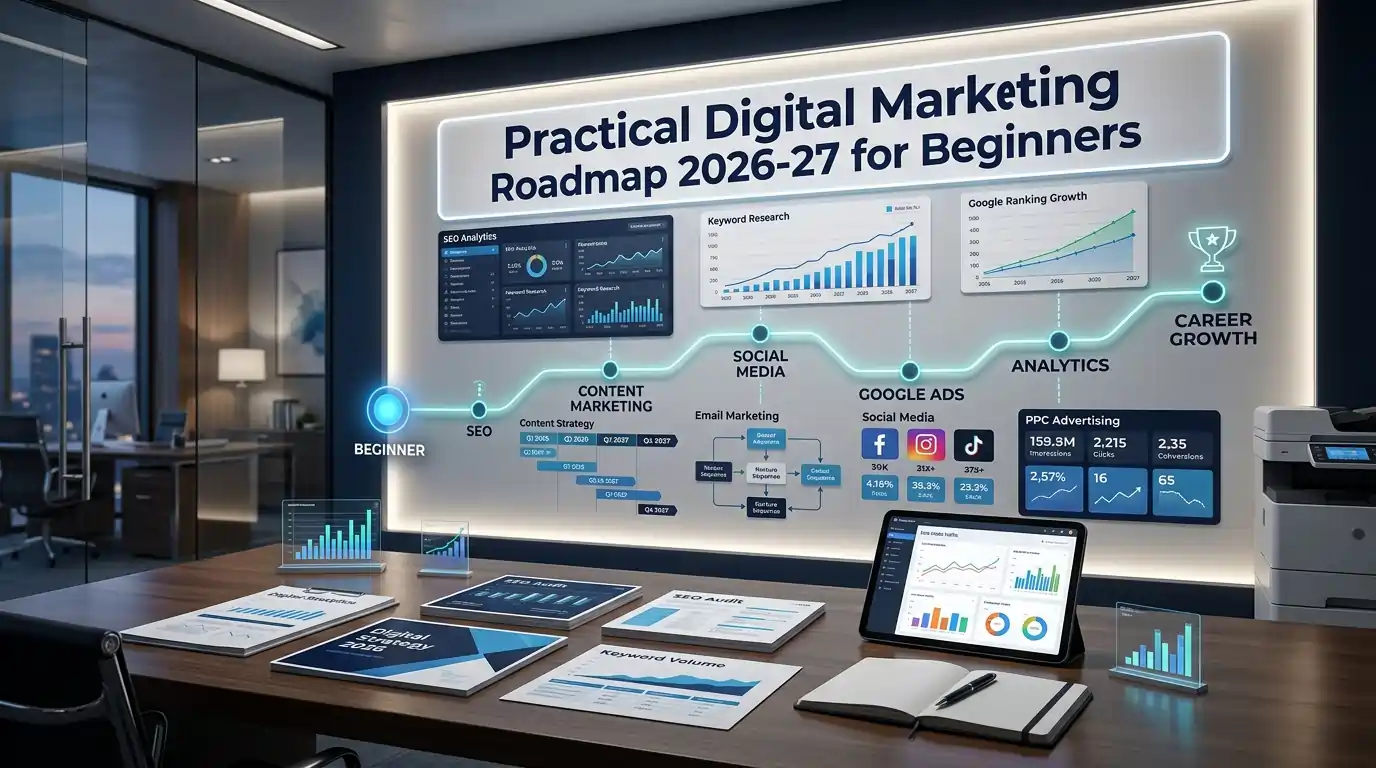
Let’s be honest – when you first type “how to start a digital marketing career” into Google, you get back hundreds of articles, YouTube videos, and course ads all screaming for your attention, each promising to be the definitive guide. But most of them either give you a shallow overview that leaves you confused about what to actually do next, or they try to sell you a course before you even understand what digital marketing roadmap really is.
This guide is different. What you’re reading right now is a properly structured, honest, and deeply practical digital marketing career roadmap – one that walks you through every single stage of your journey, from knowing absolutely nothing to becoming a confident, job-ready digital marketing professional. Whether you are a college student exploring options after graduation, a working professional from a different field thinking about a career switch, or even a small business owner who wants to handle their own marketing – this digital marketing career guide is written for you.
The beauty of digital marketing as a career is that it doesn’t discriminate. You don’t need a specific degree, a technical background, or lakhs of rupees in course fees to get started. What you need is the right digital marketing learning path, consistent effort, and the willingness to learn by doing. If you have those three things, you’re already ahead of most people who say they want to get into this field but never take the first step.
So let’s stop overthinking it. Here is your complete, step-by-step digital marketing roadmap for 2026 – with everything you need to know laid out clearly, honestly, and in the right order.
What Is a Digital Marketing Career Roadmap and Why Do You Need One?
A digital marketing roadmap is essentially a structured navigation plan for your career. Think of it like Google Maps – you enter your destination (a successful career in digital marketing), and it calculates the most efficient route for you to get there, telling you exactly where to turn, what to avoid, and how far you still have to go.
Without a roadmap, most beginners make the same costly mistake: they start learning things randomly. They watch a few YouTube videos on SEO one day, then switch to a Facebook Ads tutorial the next, then sign up for a copywriting course after seeing an ad – and before long, they’ve spent months consuming content without actually building any real, usable skills. Sound familiar? That’s what happens when you learn without a plan.
A well-designed digital marketing roadmap gives you three major advantages:
- Clarity: You know exactly what to learn, in what sequence, and why each skill matters before you move to the next one.
- Efficiency: You stop wasting time on content that isn’t relevant to your stage and focus only on what will move the needle right now.
- Confidence: When you follow a structured path and see yourself progressing, your motivation stays high and you’re far less likely to quit halfway through.
A complete roadmap typically covers the core skills and channels to master, the tools and platforms used by real professionals, certifications worth pursuing, the different career paths available to you, and a realistic timeline so you know what to expect.
Also Read – 7 Proven Techniques of the Best Digital Marketing Company in Bhopal
Why Digital Marketing Is One of the Smartest Career Choices in 2026
Before diving into the technical roadmap, it’s worth taking a moment to understand why digital marketing is such a compelling career choice right now – because this context will actually motivate you to stay consistent when things get challenging.
India’s digital economy is growing at an extraordinary pace. With over 800 million internet users, a booming e-commerce sector, and businesses of every size – from roadside vendors to large corporations – actively shifting their marketing budgets online, the demand for skilled digital marketing professionals has never been higher. And the supply? Still nowhere near enough to match the demand.
What makes this even better for someone entering the field today is the sheer diversity of opportunities. Digital marketing isn’t a single job – it’s an entire ecosystem of roles, each requiring a different combination of skills. You can choose to specialize in SEO, work as a paid advertising expert, build a career as a content strategist, manage social media for brands, or step into a full-stack digital marketing management role. And unlike many other career paths, the field rewards skill and results over degrees and pedigree.
Here’s what makes digital marketing particularly attractive:
- High and growing demand across all industries: Every industry – healthcare, education, real estate, retail, finance – now needs digital marketers. This means you’re never locked into a single sector.
- Flexibility that few careers offer: Digital marketing is one of the few career paths where you can genuinely work remotely, freelance from anywhere, or build your own consultancy without a large upfront investment.
- Relatively fast entry for beginners: With focused effort, most people can build enough skills to land their first opportunity within 6 to 12 months – which is significantly faster than many other professional career paths.
- Skills that directly translate to business growth: Unlike some corporate roles where impact is hard to measure, digital marketing results are visible, trackable, and directly tied to business outcomes – which makes skilled professionals extremely valuable.
- Entrepreneurial applications: If you ever plan to start your own business, digital marketing skills will save you enormous amounts of money and give you a massive competitive advantage from Day 1.
| Did You Know?India’s digital advertising market is projected to exceed ₹50,000 crore by 2026 – making it one of the fastest-growing digital ad markets in the entire Asia-Pacific region. According to industry estimates, this growth will create demand for over 20 lakh trained digital marketing professionals in India alone over the next few years. The talent gap is real, and it works strongly in favor of anyone willing to invest time in building genuine skills right now. |
Digital Marketing Career Roadmap for Beginners: The Right Place to Start
Here is the most important thing to understand if you’re just beginning: the digital marketing learning roadmap step by step is not about learning everything at once. It’s about learning the right things in the right order. Most beginners fail not because they lack intelligence, but because they try to run before they can walk – and end up either confused or burned out.
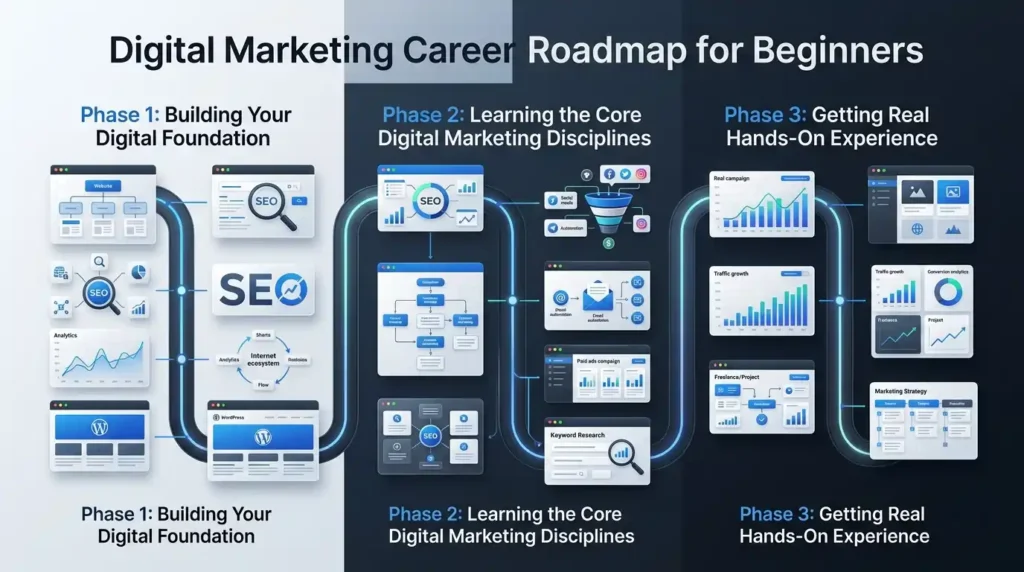
The roadmap is divided into clear phases, each building naturally on the one before it. Let’s go through each one in detail.
Phase 1: Building Your Digital Foundation
Before you touch your first marketing tool or start a digital marketing course, you need to have a solid understanding of how the digital ecosystem actually works. This is the foundation that everything else stands on, and skipping it is like trying to build a house without laying the groundwork.
At this stage, your goal is to understand – at a practical level – how the internet works, how websites are built and structured, how search engines crawl and decide what to show users, how social media algorithms distribute content, and why data and analytics are central to every decision a digital marketer makes. You don’t need to become a programmer or a data scientist. You just need to understand the logic behind these systems well enough to work with them confidently.
Practical actions for this phase:
- Spend time reading basic SEO and web guides (Moz, Google’s own documentation, and Search Engine Journal are excellent free resources)
- Set up a free WordPress blog – this single action will teach you more about websites than any course can
- Create accounts on major social platforms and study how content performs differently across each one
- Install Google Analytics 4 on your blog and simply explore what data it shows you, without worrying about understanding it perfectly yet
Phase 2: Learning the Core Digital Marketing Disciplines
Once you have a solid foundation, it’s time to start building actual digital marketing skills across the major channels. Think of this as getting your licence – you’re learning the fundamentals of how to drive before you start taking on long, complex journeys.
The core disciplines you need to understand before choosing a specialization are:
- Search Engine Optimization (SEO): This is the practice of improving a website’s visibility in organic (non-paid) search results. It includes keyword research, creating optimized content, building backlinks, and ensuring your website is technically healthy. SEO is the backbone of digital marketing and is worth spending significant time on early.
- Content Marketing: Content is the fuel that powers every other channel in digital marketing. Whether it’s blog posts, social media captions, email newsletters, or YouTube videos – the ability to create content that educates, entertains, or solves problems for your audience is an invaluable skill. Learn how to write clearly, structure content for readability, and optimize it for both humans and search engines.
- Social Media Marketing (SMM): Every major platform – Instagram, LinkedIn, Facebook, YouTube, Twitter/X – has its own content formats, audience behavior, and algorithm logic. At this stage, learn the fundamentals of building a brand presence, creating a content calendar, growing an audience organically, and reading platform analytics.
- Email Marketing: Despite being one of the oldest digital channels, email marketing consistently delivers the highest return on investment of any marketing channel. Learn how to build an email list, create effective email sequences, segment audiences, and use automation to nurture leads over time.
- Web Analytics: The ability to read, interpret, and act on data is what separates average digital marketers from great ones. Google Analytics 4 and Google Search Console are the two most essential tools to learn at this stage.
Phase 3: Getting Real Hands-On Experience
This is the phase that most people either rush through or skip entirely – and it’s the most important one. Digital marketing is not a subject you can truly learn from books and videos alone. You have to get your hands dirty, make mistakes, and figure out what works in practice.
The goal here is to create real-world examples of your work – not simulated exercises, but actual projects with actual results that you can show to future employers or clients. Some practical ways to do this include:
- Starting your own blog and systematically applying every SEO technique you learn to see what actually produces ranking improvements
- Volunteering to manage social media for a local business, a friend’s startup, or an NGO – even for free initially – to build real case studies
- Running a small Google Ads or Meta Ads campaign with a minimal budget (even ₹500-₹1000 is enough to understand how paid campaigns work)
- Doing freelance projects on platforms like Internshala, Upwork, or LinkedIn where you can build your portfolio while earning
Also Read – What is SEO? A Complete Beginner’s Guide to Search Engine Optimization (2026)
The Complete Digital Marketing Learning Path – Skills at Every Stage
To make your learning journey clearer, here’s a structured view of the skills you need to focus on at each stage – from complete beginner to digital marketing professional:
| Stage | Level | Key Skills to Learn | Estimated Timeframe |
| Foundation | Beginner | How the internet works, website basics, SEO fundamentals, Google Analytics intro | Month 1-2 |
| Core Skills | Beginner-Intermediate | On-page & off-page SEO, content writing, social media strategy, email marketing basics | Month 2-4 |
| Paid Advertising | Intermediate | Google Ads, Meta Ads, campaign setup, audience targeting, conversion tracking | Month 4-6 |
| Advanced Strategy | Advanced | Marketing automation, CRO, A/B testing, funnel building, data-driven decision making | Month 6-9 |
| Specialization & Growth | Expert | Deep-dive into chosen niche, build portfolio, apply for roles or freelance | Month 9 onwards |
Digital Marketing Training Roadmap 2026 – Certifications Worth Your Time
Let’s talk about certifications – because this is one of the most misunderstood parts of the digital marketing training roadmap 2026. The internet is full of paid certifications claiming to be the golden ticket to a high-paying job. The truth is far more nuanced.
Certifications do have value – but only in the right context. They signal to potential employers that you’ve invested time in structured learning and that you understand industry-standard concepts. More importantly, the best certifications force you to engage with real platforms, real tools, and real campaign structures – which accelerates your practical learning significantly.
The great news is that the most credible certifications in digital marketing are completely free. Here are the ones actually worth pursuing:
| Certification | Platform | What It Covers | Best For | Cost |
| Google Digital Garage – Fundamentals | Broad digital marketing overview covering all major channels | Complete beginners getting started | Free | |
| Google Ads Certification | Google Skillshop | Search, Display, Video, Shopping, and App campaigns | Those pursuing a PPC or paid advertising career | Free |
| Google Analytics 4 (GA4) | Google Skillshop | Website analytics, events, conversions, audience insights | Anyone working with websites or data | Free |
| HubSpot Content Marketing | HubSpot Academy | Content strategy, blogging, SEO, repurposing, distribution | Content writers, bloggers, and inbound marketers | Free |
| HubSpot Email Marketing | HubSpot Academy | Email strategy, list growth, automation, A/B testing | Email marketers and automation specialists | Free |
| Meta Blueprint Certification | Meta | Facebook & Instagram Ads, audience targeting, campaign optimization | Social media managers and paid social specialists | Free |
| SEMrush SEO Toolkit Course | SEMrush Academy | Technical SEO, keyword research, competitor analysis, link building | SEO analysts and content strategists | Free |
| Orphic Solution Training Program | Orphic Solution, Bhopal | Live project training across all digital marketing channels | Structured, mentor-led learning with real campaign experience | Affordable |
An important note: Completing a certification and putting it on your resume is step one. But what will actually get you hired – or win you clients – is the ability to say, “I earned this certification and then I applied it to a real project and got these results.” Pair every certification you earn with a practical project immediately. The combination of credential plus demonstrated result is extremely powerful.
| Did You Know? A survey conducted across digital marketing hiring managers found that 82% of them rank hands-on project experience above certifications when evaluating candidates. One of the most common complaints from recruiters is that candidates arrive with certificates but cannot answer basic questions about how they would approach a real campaign. The takeaway is clear: certifications open doors, but real experience walks you through them. Start building your portfolio from the very first week of learning – don’t wait until you feel “ready.” |
Digital Marketing Skills Roadmap – A Deep Dive Into What You Need to Master
The digital marketing skills roadmap can be divided into two broad categories: technical skills that are specific to digital marketing tools and platforms, and soft skills that are transferable across every career but are particularly critical in this field. Both categories matter, and neglecting either one will limit your growth.
Technical Skills You Need to Build
These are the hard, learnable skills that are directly tied to executing digital marketing campaigns and strategies. The more fluently you can work with these, the more valuable you become:
- Search Engine Optimization (SEO): This includes understanding keyword intent and research, writing and optimizing meta titles and descriptions, building internal linking structures, earning high-quality backlinks, fixing technical website issues like slow page speed and crawl errors, and understanding how Google’s algorithm evaluates content quality.
- Paid Advertising (PPC): Google Ads and Meta Ads are the two most important platforms to master. Skills include structuring campaigns and ad groups logically, writing compelling ad copy, setting up conversion tracking, managing bidding strategies, creating retargeting audiences, and optimizing based on performance data.
- Content Creation and Copywriting: The ability to write content that ranks on search engines, resonates with human readers, and drives them toward taking action is one of the most in-demand skills in the entire field. This includes blog writing, landing page copywriting, email writing, ad copy, social media captions, and video scripts.
- Web Analytics and Data Interpretation: Knowing how to set up tracking, read reports, identify patterns, and translate data insights into actionable decisions is what makes you genuinely strategic rather than just tactical. GA4, Google Search Console, and Meta Ads Manager data analysis are the core skills here.
- Email Marketing and Automation: Building segmented email lists, creating welcome sequences and drip campaigns, setting up behavioral triggers, testing subject lines and CTAs, and maintaining email deliverability are all critical competencies for this channel.
- Social Media Content Strategy: Beyond just posting content, the real skill is in understanding how algorithms work on different platforms, what content formats perform best, how to build and engage an audience consistently, and how to analyze performance data to refine your approach.
Soft Skills That Separate Good Marketers From Great Ones
These are often overlooked in digital marketing training programs, but they are just as important as any technical skill:
- Analytical thinking: Digital marketing is fundamentally a data-driven discipline. The ability to look at numbers, identify what they mean, form hypotheses, and test them systematically is invaluable.
- Creative problem-solving: When a campaign isn’t performing, you need to think creatively about why and what to try differently. When a competitor is outranking you, you need to think strategically about how to close the gap.
- Written communication: So much of digital marketing happens through written words – emails, ads, blog posts, social captions, reports. Being able to write clearly, persuasively, and appropriately for different audiences is a huge advantage.
- Adaptability: Google updates its algorithm hundreds of times a year. Social platforms change their features constantly. Ad platforms evolve. The most successful digital marketers are those who embrace change rather than resist it.
- Project management: As you grow in your career, you’ll be managing multiple campaigns, deadlines, clients, and stakeholders simultaneously. The ability to prioritize, stay organized, and communicate progress clearly is what gets you promoted.
Also Read – What Is Social Media Marketing? A Complete Beginner’s Guide (2026)
Digital Marketing Career Paths – Understanding Your Options
One of the most exciting parts of following a digital marketing job roadmap is realizing just how many different directions your career can go once you’ve built your foundational skills. Digital marketing is not a single job – it’s a family of related roles, each with its own focus, skill set, and career trajectory. Here’s a detailed look at the major paths available to you:
| Role | What You’ll Do | Avg Salary (India) | Key Skills Needed |
| SEO Analyst / SEO Manager | Research keywords, optimize website content and structure, build backlinks, track rankings and organic traffic growth | ₹3-8 LPA | Keyword research, technical SEO, content optimization, link building |
| Social Media Manager | Manage brand presence across platforms, create content calendars, run organic campaigns, analyze engagement metrics | ₹3-6 LPA | Content creation, platform algorithms, analytics, brand strategy |
| PPC / Paid Ads Specialist | Set up and manage paid campaigns on Google and Meta, optimize bidding and targeting, track conversions and ROI | ₹4-10 LPA | Google Ads, Meta Ads, conversion tracking, data analysis |
| Content Marketing Manager | Develop content strategy, oversee blog and video production, manage SEO content, track content performance | ₹4-9 LPA | Copywriting, SEO, editorial planning, content distribution |
| Email Marketing Specialist | Build email lists, create automated workflows, write email sequences, optimize open and click rates | ₹3-7 LPA | Email platforms, automation, A/B testing, copywriting |
| Digital Marketing Manager | Oversee all digital channels, lead a team, develop overall strategy, report to leadership on ROI | ₹7-18 LPA | Strategy, team management, analytics, all digital channels |
| Freelance Digital Marketer | Manage multiple client accounts independently, source and retain clients, deliver results across various industries | ₹20K-₹1L+/month | Self-marketing, client management, project execution, business skills |
Freelance vs Full-Time Digital Marketing Career: Which Path Is Right for You?
One of the questions we get asked most often at Orphic Solution is whether someone should pursue a salaried role at a company or agency, or go straight into freelancing. There’s no universally correct answer – it completely depends on your personality, your financial situation, your current skill level, and your long-term goals.
Here’s an honest, detailed comparison to help you make an informed decision:
| Factor | Freelance Digital Marketer | Full-Time Employee |
| Income Stability | Variable and unpredictable – particularly in the early months when you’re still building your client base. Income can range dramatically from one month to the next. | Stable, predictable monthly salary with additional benefits like PF, health insurance, and paid leave. |
| Learning & Growth Speed | Very fast exposure to diverse industries, challenges, and strategies. Every client is different, which forces you to constantly expand your thinking. | Deeper exposure to one company’s strategy and market. Growth is more focused but potentially slower in breadth. |
| Flexibility & Autonomy | High – you set your own working hours, choose your clients, and work from anywhere. This freedom is one of the biggest draws of freelancing. | Typically more structured with set hours, team collaboration, and management hierarchy. |
| Career Progression | Entirely self-driven. You build your reputation through client results, referrals, and personal branding. There are no formal promotions. | Clear progression path with appraisals, promotions, and the ability to move into management roles. |
| Skill Building | Broad – you’ll encounter a huge variety of problems across industries and platforms, which builds versatility. | Deep – you become an expert in your company’s specific channels, audience, and strategy. |
| Best Suited For | Self-starters with strong discipline, good communication skills, tolerance for financial uncertainty, and entrepreneurial drive. | Those who prefer structure, value stability, enjoy teamwork, and want a defined career progression path. |
Our honest recommendation: If you’re starting out, spend your first 1-2 years in a full-time role at an agency or in-house marketing team. The structured environment, mentorship, and exposure to real campaigns will accelerate your learning in ways that are very hard to replicate when you’re freelancing from scratch. Once you have a track record of results, a professional network, and confidence in your skills, transitioning to freelancing or starting your own consultancy becomes a much more viable and rewarding move.
Digital Marketing Study Plan – A Realistic Month-by-Month Breakdown
A digital marketing study plan is only useful if it’s actually achievable alongside your existing life commitments. The plan below is designed to work with 2-3 hours of focused daily effort – which is realistic for most students and working professionals. The key is consistency over intensity.
Month 1-2: The Foundation Phase
In these first two months, resist the temptation to jump ahead. Spend this time building a genuinely solid understanding of how digital marketing works as a system, not just as a collection of individual tactics.
- Complete the Google Digital Garage ‘Fundamentals of Digital Marketing‘ course (it’s free and takes about 40 hours)
- Read the Moz Beginner’s Guide to SEO and the Google Search Essentials documentation in full
- Set up your own WordPress website or blog – even a basic one about a topic you’re interested in
- Install Google Analytics 4 and Google Search Console on your site and spend time exploring what the dashboards show
- Start writing your first 2-3 blog posts, focusing on structuring them clearly and targeting a specific keyword
Month 3-4: Core Skills Development
With your foundation in place, it’s time to systematically build skills across the most important channels.
- Complete the HubSpot Content Marketing and Email Marketing certifications
- Start doing keyword research using free tools like Google Keyword Planner and Ubersuggest – identify 20 keywords to target on your blog
- Begin consistently creating and publishing content – aim for at least 2 posts per week to start seeing meaningful data
- Start managing a social media account – yours, a local business’s, or create one specifically as a learning project
- Set up a basic email list using Mailchimp’s free plan and write a simple welcome sequence
Month 5-6: Paid Advertising Skills
Paid advertising is where many beginners feel intimidated – which is exactly why most people delay it. Don’t. The earlier you understand how paid campaigns work, the more valuable you become.
- Complete the Google Ads certifications on Google Skillshop – work through Search, Display, and Shopping
- Complete Meta Blueprint for Facebook and Instagram Ads
- Run a small paid campaign with a minimal budget – even ₹500 is enough to understand the fundamentals of how ad auctions work, what happens when you change targeting, and how to read campaign metrics
- Start documenting everything you try and the results you get – these notes will become your case studies
Month 7-9: Portfolio, Specialization & Opportunities
By this stage, you have genuine skills and real results to show. Now it’s time to package everything you’ve built and start actively pursuing opportunities.
- Build a simple portfolio website showcasing your projects – include your blog traffic growth, social media results, and any ad campaign outcomes
- Write 2-3 detailed case studies: “I helped [X business/project] achieve [Y result] by doing [Z strategy]”
- Decide on a primary specialization based on what you’ve enjoyed most and shown the best results in
- Apply for internships, entry-level roles, or start reaching out to small businesses about freelance projects
- Join digital marketing communities – LinkedIn groups, Reddit communities, and local professional networks
| Did You Know?A common misconception among beginners is that they need to wait until they’re “fully ready” before applying for jobs or pitching clients. In reality, most successful digital marketing professionals will tell you they were still learning on the job well into their first 2-3 years of their career. The industry expects you to grow continuously – what matters when you start is that you can demonstrate genuine curiosity, a methodical approach to problem-solving, and at least one or two tangible results from your own projects. You don’t need to be perfect to start. You need to start to become good. |
Common Mistakes to Avoid on Your Digital Marketing Learning Path
Even the most motivated learners make mistakes on their digital marketing learning path – and most of these mistakes are entirely avoidable once you know what to watch out for. Here are the most common ones, explained in enough detail to help you genuinely steer clear of them:
- Trying to learn everything simultaneously: This is probably the single most common reason beginners give up. Digital marketing has dozens of sub-disciplines, and no one masters all of them at once. Follow the phased approach in this roadmap – go broad first to understand how everything connects, then go deep in one or two areas before branching out further.
- Consuming content without applying it: It feels productive to watch videos and read articles all day. It isn’t. Real learning in digital marketing happens through application – running a campaign, writing an optimized article, analyzing data, testing a hypothesis. Every time you learn a new concept, your next immediate action should be to apply it somewhere, even on a small scale.
- Ignoring data and analytics: Many beginners skip analytics because it feels intimidating or “not their thing.” This is a serious mistake. Digital marketing without data is just guessing. Even basic proficiency in Google Analytics 4 and Search Console will make you dramatically more effective and far more hireable.
- Not building a portfolio: A portfolio is your proof of work – it tells employers and clients that your skills are real, not theoretical. And you don’t need impressive results to start. Even small wins – a blog post that ranks on page 2, a social media page that grew from 100 to 500 followers, an email campaign with a 30% open rate – are worth documenting and presenting professionally.
- Chasing every new tool and trend: The digital marketing world is full of shiny new tools, emerging platforms, and “must-know” trends. Most of them are either fleeting or only relevant to specific niches. Stay focused on the fundamentals – SEO, content quality, audience targeting, conversion optimization, and data analysis are timeless skills that will serve you regardless of what platforms come and go.
- Neglecting personal branding: Your LinkedIn profile, your portfolio website, the content you share publicly – these are all part of your professional identity as a digital marketer. It’s deeply ironic to be applying for digital marketing roles with a blank LinkedIn profile. Start building your personal brand from Day 1, and let it grow alongside your skills.
Also Read – How to Become a Social Media Manager
How Orphic Solution Can Help You Build Your Digital Marketing Career Faster
Following a self-directed learning roadmap is absolutely possible – and this guide gives you everything you need to do exactly that. But if you want to compress your learning timeline, learn from practitioners who run real campaigns every day, and get the kind of structured mentorship that accelerates your growth significantly, then professional training is worth serious consideration.
Orphic Solution is a full-service digital marketing company based in Bhopal, Madhya Pradesh, and we offer hands-on, results-oriented training programs designed specifically for individuals who want to build a real career in digital marketing – not just collect certificates.
Here’s what makes our training different from generic online courses:
- Live project exposure from Day 1: You don’t practice on simulated scenarios. You work on actual client campaigns – real SEO projects, live social media accounts, running ad campaigns with real budgets. This gives you the kind of experience that online courses simply cannot replicate.
- Expert mentorship from practitioners: Our trainers are not just educators – they are working digital marketing professionals who manage live campaigns, real clients, and measurable results every single day. You learn from people who are actively solving the same problems you’ll face in your career.
- Comprehensive curriculum: The training covers SEO, social media marketing, Google Ads, content writing, web development basics, email marketing, and analytics – giving you a full-stack understanding of how digital marketing works as an integrated system.
- Career support that goes beyond the classroom: We help you build your portfolio, prepare your resume, practice for interviews, and connect with real opportunities. Our goal isn’t just to train you – it’s to help you successfully transition into a digital marketing career.
- Flexible for students and working professionals: Our programs are designed to fit around your existing commitments, with both weekday and weekend options available.
To learn more about our training programs or to speak with our team directly, visit training.orphicsolution.com or call us at 09993772685.
Frequently Asked Questions About the Digital Marketing Career Roadmap
1. What is the best digital marketing roadmap for beginners in 2026?
The best digital marketing roadmap for beginners starts with understanding how the internet and search engines work, then systematically learning SEO, content marketing, social media, email marketing, and paid advertising – in that specific sequence. The reason this order matters is that each skill builds on the previous one. Once you’ve completed that core cycle, you should earn recognized free certifications from Google, HubSpot, and Meta while simultaneously working on real-world projects to build your portfolio. With consistent daily effort of 2-3 hours, most beginners can achieve job-ready proficiency within 6-9 months.
2. How long does it actually take to learn digital marketing step by step?
This depends heavily on how consistently you study and – more importantly – how actively you practice what you’re learning. With 2-3 hours of focused daily effort that includes both learning and application, most people can build genuine, job-ready skills within 6 to 12 months. Getting to a point of deep specialization in a specific channel like SEO or paid advertising takes an additional 3-6 months of concentrated practice. The learners who progress fastest are almost always those who start applying skills immediately rather than waiting until they feel fully prepared.
3. Which digital marketing skill should I learn first as a complete beginner?
Start with SEO and content marketing – these two disciplines form the foundation of virtually everything else in digital marketing. Understanding how search engines work, how to identify what people are searching for (keyword research), and how to create content that ranks and resonates with audiences will give you a mental model that makes every subsequent skill far easier to understand and apply. Paid advertising, social media strategy, and email marketing all make much more sense once you understand the fundamentals of SEO and content.
4. Is digital marketing a good career option in India in 2026?
Digital marketing is unquestionably one of the strongest career choices in India right now. The combination of rapidly growing internet penetration, a booming e-commerce and startup ecosystem, and businesses across every sector increasing their digital advertising budgets has created a genuine talent shortage. Skilled digital marketing professionals – especially those who can demonstrate real results – are in high demand and can command competitive salaries, strong career growth, and the flexibility to work across multiple industries or independently as freelancers.
5. Can I build a successful digital marketing career without a formal degree?
Absolutely. Digital marketing is one of the most genuinely skill-first career fields in existence. Unlike medicine or law, there is no formal degree requirement, and many of the most successful digital marketing professionals in India are entirely self-taught. What matters to employers and clients is not where you studied, but what you can demonstrate – your portfolio, your certifications from credible platforms like Google and HubSpot, the results you’ve achieved on real projects, and your ability to think strategically about marketing challenges. A strong portfolio will consistently outperform a degree in this field.
6. What tools do I absolutely need to learn on my digital marketing learning path?
The tools that appear most consistently in job descriptions and client requirements are: Google Analytics 4 for website analytics and user behavior tracking; Google Search Console for monitoring SEO performance and identifying technical issues; SEMrush or Ahrefs for keyword research, competitor analysis, and backlink monitoring; Google Ads and Meta Ads Manager for paid advertising campaign management; Mailchimp or HubSpot for email marketing and automation; Canva for creating visual content without graphic design expertise; and WordPress for website management. Proficiency in these tools will make you immediately useful in most digital marketing roles.
Conclusion: Your Digital Marketing Career Starts With One Decision
If you’ve read this far, you now have something that most aspiring digital marketers never get: a clear, honest, and thoroughly practical digital marketing roadmap that tells you exactly what to do, in what order, and why it matters. The question is no longer whether you have enough information to get started – you do. The question is whether you’re going to act on it.
The digital marketing learning path we’ve laid out in this guide – from building your digital foundation to mastering core skills, earning meaningful certifications, developing a portfolio, and choosing your career direction – is a proven framework that works for complete beginners and career changers alike. It’s not magic, and it doesn’t happen overnight. But with consistent effort applied in the right direction, it absolutely works.
The most important thing to remember is this: the digital marketing professionals who succeed are not necessarily the most naturally talented or the best-educated. They are the most consistent. They show up every day, they apply what they learn, they document their results, they learn from their mistakes, and they keep going even when progress feels slow. That combination of persistence and practical focus is what builds a career in this field.
So here is your action plan for today – not next week, not after you finish one more course, but today:
- Decide which phase of the roadmap you’re currently in
- Identify the single most important skill or action for your stage right now
- Spend the next 30 minutes on that skill – not planning, not researching, but actually doing
- Repeat tomorrow and the day after
And if you want expert guidance, live project experience, and career support to accelerate your journey, Orphic Solution’s training programs in Bhopal are designed exactly for that purpose. We’re not just a digital marketing company – we’re a team of practitioners who are passionate about helping the next generation of marketers build skills that are real, results-oriented, and career-defining.
Digital Marketing Tips
Best Digital Marketing Institute in India: The Only Complete Guide You Will Ever Need
Are you searching for the best digital marketing institute in India but do not know where to start? You are not alone. Every single day, thousands of students, fresh graduates, and working professionals search for the right place to learn digital marketing – and most of them end up confused because there are just too many options out there.
Some institutes promise the world but deliver very little. Some charge high fees but have outdated content. And some have no placement support at all. So how do you know which one is truly worth your time and money?
That is exactly why this guide exists.
This blog will walk you through everything you need to know – what a digital marketing training institute actually is, why it matters in today’s world, how to pick the right one, what the syllabus looks like, how much it costs, and which institute truly stands out. We have also answered the most common questions people ask online.
So, if you are serious about building a career in digital marketing – keep reading. This guide will make your decision much easier.
What is a Digital Marketing Institute? And Why Does It Matter?
Let us start from the very beginning. A digital marketing course institute is a place – either offline or online – where you learn the skills needed to market businesses, products, and services on the internet.
But it is more than just learning theory. A good digital marketing training institute teaches you how to actually do the work. You learn how to run Google Ads, how to rank a website on the first page of Google, how to grow a brand’s social media presence, how to write content that attracts readers, and how to turn website visitors into paying customers.
Think of it this way – if you want to become a doctor, you go to a medical college. If you want to become an engineer, you go to an engineering college. And if you want to become a digital marketing professional, you go to a digital marketing academy India that gives you the right training, tools, and experience.
The difference between watching free YouTube videos and joining a proper institute is huge. On YouTube, you get scattered information with no structure. At an institute, you follow a step-by-step path. You have a trainer who guides you, assignments that test your knowledge, live projects that sharpen your skills, and a certification that proves your abilities to employers.
So, a digital marketing classes institute is not just a place to learn – it is a launchpad for your career.
Also Read: How AI is Changing Digital Marketing
Why Should You Join a Digital Marketing Institute in India Right Now?
This is one of the most important questions. And the answer is very simple – because the digital world is growing faster than ever, and India is right in the middle of this revolution.
Here is what is happening in India right now:
- Over 750 million people in India use the internet today
- India has the second largest social media user base in the world
- Businesses – big and small – are moving online rapidly
- The demand for skilled digital marketers is growing every year
- But the supply of truly trained professionals is still very low
This gap between demand and supply is your opportunity. When you join a digital marketing training institute, you position yourself right at the center of this opportunity.
And it is not just about jobs. Digital marketing skills also help you:
- Start your own freelancing business and work from anywhere
- Grow your own business online without spending a fortune on advertising
- Help local businesses in your city and earn good money
- Build your personal brand on social media and become an influencer
So why should you join right now? Because the window of opportunity is open – and those who act now will always have an edge over those who wait.
Did You Know? India’s digital advertising industry is projected to grow to ₹35,000 crore by 2026. This explosive growth means companies across every industry are desperately looking for skilled digital marketers. If you have the right skills, getting a job or clients will never be a problem.
Who Should Join a Digital Marketing Institute?
One of the best things about digital marketing is that it is for everyone. It does not matter what your educational background is. It does not matter which stream you studied – science, commerce, or arts. And it does not matter how old you are.
Here is a clear picture of who can benefit from joining the best digital marketing institute in India:
Students After 12th or Graduation If you are a student who just finished school or college, digital marketing can give you a head start in your career. Instead of spending years on a traditional degree with uncertain job prospects, you can complete a 3-6 month course and start earning much sooner.
Freshers Looking for a Job If you have just graduated and are struggling to find a good job, adding a digital marketing certification to your resume can make a huge difference. Companies today prefer candidates who have practical digital marketing skills.
Working Professionals Wanting a Career Switch If you are in a job that you do not enjoy – or in a field that is not growing – digital marketing is one of the best career switches you can make. The skills are in demand, the salaries are good, and the learning curve is not as steep as in technical fields like coding or data science.
Business Owners Who Want to Grow Online If you own a business and are spending money on digital marketing without understanding it, you are at a disadvantage. Joining a marketing training center will help you understand exactly how your money is being spent, what strategies work, and how to get better results.
Homemakers and Freelancers Digital marketing is one of the few skills that can be learned and practiced from home. If you are looking for a way to earn from home – whether full-time or part-time – digital marketing freelancing is a very real and rewarding option.
So, who should join? Almost everyone. If you want to grow – personally, professionally, or in business – digital marketing is the skill for you.
When is the Right Time to Join a Digital Marketing Institute?
Many people delay making decisions by waiting for the “perfect time.” But in the world of digital marketing, there is no perfect time. The best time was yesterday. The second best time is today.
Here is why you should not wait:
Every month you delay is a month your competitors are learning and growing. The students who joined digital marketing courses two years ago are now getting promoted, earning freelance income, and building their brands. The ones who waited are still thinking about it.
Also, the job market is becoming more competitive every year. Companies are now asking for candidates with specific digital marketing certifications and project experience. The sooner you start, the more experience you build – and the stronger your profile becomes.
Whether you are in college, just graduated, or thinking about a career change at any age – when is the right time? Right now.
Did You Know? According to LinkedIn’s India Jobs Report, Digital Marketing Specialist is consistently ranked among the Top 10 most in-demand jobs in India. Entry-level digital marketers in India earn between ₹15,000 to ₹35,000 per month, and experienced professionals can earn ₹50,000 to ₹1,50,000 per month or more.
What to Look for in the Best Digital Marketing Institute in India?
Now that you know why and who, let us talk about what you should check before joining any institute. Not all institutes are equal. Some are great, some are average, and some are simply not worth your time or money. Here is a detailed checklist of everything you should evaluate:
Course Structure and Syllabus – Is It Complete?
The first thing to check is the digital marketing institute course structure. Before you pay even a single rupee, ask the institute for their complete syllabus. A truly good digital marketing institute syllabus should cover these core areas:
- Search Engine Optimization (SEO) – On-page, off-page, technical SEO
- Social Media Marketing (SMM) – Facebook, Instagram, LinkedIn, Twitter
- Google Ads / Pay-Per-Click (PPC) – Search ads, display ads, shopping ads
- Content Marketing – Blogging, storytelling, content strategy
- Email Marketing – List building, automation, newsletters
- Website Design and WordPress – Building and managing websites
- Google Analytics and Reporting – Understanding data and performance
- YouTube Marketing – Video SEO and advertising
- E-commerce Marketing – Amazon, Flipkart, Shopify strategies
- Affiliate Marketing – Earning commissions online
- Freelancing Guidance – How to get clients and manage projects
- Career Guidance and Interview Prep – Resume building and job search
If an institute covers only 3-4 of these topics, that is not enough. You need the complete package to compete in today’s market.
Duration of the Course – How Long Will It Take?
How long you study depends on the program you choose. Here is a clear breakdown:
| Course Type | Duration | Best For |
| Short-Term Crash Course | 1 – 3 Months | Quick skill upgrade |
| Diploma in Digital Marketing | 3 – 6 Months | Beginners & freshers |
| Advanced Digital Marketing | 6 – 9 Months | Career switchers |
| Master Digital Marketing Program | 9 – 12 Months | Deep expertise seekers |
| Weekend / Part-Time Batches | 3 – 9 Months | Working professionals |
A digital marketing institute duration of 4-6 months is usually the sweet spot for most beginners. It is long enough to cover everything properly, and short enough that you can start working or freelancing quickly after completing it.
Certification – Which Certificates Will You Get?
Certifications matter. They are proof that you have learned the skill – and employers take them seriously. A strong digital marketing institute certification program should include:
- Google Certifications – Google Ads, Google Analytics, Google Search Console
- Meta Blueprint Certification – Facebook & Instagram advertising
- HubSpot Academy Certifications – Inbound marketing, content marketing
- SEMrush or Ahrefs Certifications – SEO tools expertise
- Institute Completion Certificate – Recognized by the training center
When you walk into an interview with multiple certifications on your resume, it sends a very strong signal to the employer that you are serious about your work.
Placement Support – Will They Help You Get a Job?
This is one of the most critical things to check. A best digital marketing institute with placement in India should not just teach you – it should also help you find work after the course. Here is what good placement support looks like:
- A dedicated placement cell that connects students with companies
- Resume building workshops
- Mock interview sessions with industry experts
- LinkedIn profile optimization guidance
- Job referrals to partner companies
- Freelancing support for those who want to work independently
Always ask the institute – how many students from the last batch got placed? And which companies hired them? These two questions will tell you everything about the quality of their placement program.
Fees – How Much Should You Pay?
Let us talk about digital marketing institute fees India honestly. Here is a general price range:
| Program Level | Approximate Fees |
| Basic / Short-Term Course | ₹8,000 – ₹20,000 |
| Diploma Program | ₹20,000 – ₹40,000 |
| Advanced Certification Program | ₹35,000 – ₹60,000 |
| Master / Full Stack Program | ₹55,000 – ₹1,00,000 |
Now, should you always go for the cheapest option? Absolutely not. And should you always go for the most expensive? Not necessarily. The key is value for money. Ask yourself – what am I getting for this fee? Is there live project training? Are the trainers experienced? Is there placement support? Is the curriculum updated?
A slightly higher fee at a quality institute will give you much better returns than a cheap course that teaches outdated content with no support.
Also Read : How to Start a Digital Marketing Career After 12th: Complete Roadmap for Students
How to Find the Best Digital Marketing Training Center Near You?
Finding a digital marketing training center near me is easier today than ever before. Here is a step-by-step process you can follow:
Step 1 – Google Search Open Google and type “digital marketing institute near me” or “best digital marketing course in [your city].” Look at the top results and read the reviews carefully.
Step 2 – Check Google Maps Search for institutes on Google Maps. Look at the star rating, number of reviews, and read what past students have said. This gives you a real picture of the institute’s quality.
Step 3 – Watch Free Demo Lectures on YouTube Many institutes post free lectures on YouTube. Watch a few videos from their trainers. This helps you judge the teaching quality before committing your money.
Step 4 – Visit LinkedIn Look up the institute on LinkedIn. Check the trainer profiles and see how many students they have trained. A strong LinkedIn presence is usually a good sign.
Step 5 – Attend a Free Demo Class This is the most important step. Always attend a free demo class before enrolling. This gives you a feel for the teaching style, the batch quality, and the overall environment of the institute.
Step 6 – Ask for Alumni References A confident institute will always be happy to connect you with past students. Talk to alumni and ask them about their experience – what they liked, what they did not like, and whether they got placed.
Did You Know? Students who attend a free demo class before enrolling are 4x more likely to complete the course and get positive results. A demo class helps you see the trainer’s teaching style, the course quality, and the batch environment – before spending any money. Always insist on a demo before enrolling in any digital marketing classes institute.
Also Read : Digital Marketing Skills Required: Complete Roadmap to Become a Digital Marketing Expert in 2026
What is the Full Syllabus of a Good Digital Marketing Training Program?
A well-structured digital marketing institute training programs should be both theoretical and practical. Here is what a module-by-module journey looks like at a top-quality institute:
Module 1 – Introduction to Digital Marketing Understanding the digital ecosystem, what digital marketing academy India covers, and how it differs from traditional marketing.
Module 2 – Website Basics and WordPress Building and managing websites without coding. Understanding hosting, domains, and themes.
Module 3 – Search Engine Optimization (SEO) On-page SEO, off-page SEO, technical SEO, keyword research, link building, and local SEO strategies.
Module 4 – Google Ads and PPC Creating and managing paid ad campaigns on Google Search, Display Network, YouTube, and Shopping.
Module 5 – Social Media Marketing (SMM) Growing brand presence on Facebook, Instagram, LinkedIn, Twitter, and Pinterest through organic and paid strategies.
Module 6 – Content Marketing and Blogging Writing SEO-optimized blogs, creating content calendars, and building content strategies.
Module 7 – Email Marketing Building email lists, writing effective emails, using automation tools like Mailchimp and ConvertKit.
Module 8 – YouTube and Video Marketing YouTube SEO, video ad campaigns, and using video content to drive traffic and conversions.
Module 9 – E-commerce Marketing Selling on Amazon, Flipkart, and Shopify. Managing product listings, ads, and reviews.
Module 10 – Affiliate Marketing Understanding affiliate networks and earning passive income through commissions.
Module 11 – Google Analytics and Data Reporting Reading and interpreting data, tracking campaign performance, and making data-driven decisions.
Module 12 – Freelancing, Entrepreneurship, and Career Guidance Finding clients, setting pricing, building proposals, cracking interviews, and building a strong digital profile.
This is the kind of detailed and practical training that separates a great digital marketing training institute from a mediocre one.
Which Institute is Truly the Best for Digital Marketing in India?
When people search for which institute best for digital marketing, they want a real, honest answer – not just a list of random names. The truth is, the best institute is the one that has all of these:
✅ An updated and complete syllabus ✅ Trainers with real industry experience ✅ Practical, hands-on learning from day one ✅ Recognized certifications ✅ Strong placement support ✅ Transparent fees with no hidden charges ✅ Positive reviews from past students
If an institute checks all of these boxes, it is worth your attention. And when it comes to the best digital marketing institute in India for students in Madhya Pradesh and nearby states – Orphic Solution Training is a name that stands tall.
Also Read : 7 Proven Techniques of the Best Digital Marketing Company in Bhopal
Why Choose Orphic Solution – Your Trusted Digital Marketing Academy in India?
Orphic Solution is not just a digital marketing training institute – it is a career transformation platform. Here is a detailed look at everything that makes Orphic Solution the right choice for you:
Real Industry Experience in the Classroom Our trainers are not just academics who read books. They are working professionals who have managed real client campaigns – in SEO, social media, paid advertising, and web development. When you learn from them, you are learning from people who know how the industry actually works.
100% Practical and Project-Based Learning At Orphic Solution, we do not believe in just teaching theory. From the very first week, students start working on live assignments and real projects. You will run actual Google Ads campaigns, write and publish real blogs, optimize real websites, and analyze real data. This hands-on experience is what makes our students job-ready from day one.
Complete and Updated Course Curriculum Our digital marketing institute syllabus is designed to match the current demands of the industry. We update it regularly to include the latest tools, platforms, and strategies. So you are never learning outdated content.
Multiple Certifications When you complete your training at Orphic Solution, you receive certifications from Google, Meta, HubSpot, and our own institute. These digital marketing institute certifications are recognized by employers across India and add serious weight to your resume.
Dedicated Placement Support We are proud to be a best digital marketing institute with placement in India. Our placement cell actively connects students with hiring companies. We conduct resume workshops, mock interviews, and LinkedIn optimization sessions. We do not just teach you – we help you get placed.
Affordable and Transparent Fees Our digital marketing institute fees India are structured to be accessible to students from all backgrounds. We believe quality education should not be out of reach for anyone. And there are no hidden charges – what you see is what you pay.
Flexible Batch Options We understand that not everyone has the same schedule. That is why we offer morning batches, evening batches, and weekend batches. Whether you are a full-time student or a working professional, there is a batch that fits your life.
Online and Offline Modes We offer both offline classroom training in Bhopal and online training for students from other cities. So where you live does not have to be a barrier to great education.
Regular Doubt Sessions and Mentorship Learning does not stop after class. We offer regular doubt-clearing sessions, one-on-one mentorship, and access to study materials so you can always go back and review what you learned.
Also Read : Best SEO Company in Bhopal for 2025 – Complete Guide
Your Career in Digital Marketing Starts Here – Join Orphic Solution Today!
You have read this entire guide. You now know what digital marketing is, why it matters, who should learn it, how to pick the right institute, and which one truly stands out.
Now it is time to take action.
At Orphic Solution Training, we are ready to help you build the career you have always wanted. Whether you want to get a job, start freelancing, grow your business, or simply learn a new skill – we have the right program for you.
Call Us Now: 09993772685
Website: training.orphicsolution.com
Office: Bhopal, Madhya Pradesh
Book Your FREE Demo Class Today – Seats Are Filling Fast!
FAQ – People Also Ask About Digital Marketing Institutes
Q1. Which institute is best for digital marketing?
The best digital marketing institute in India is one that offers a complete and updated syllabus, experienced trainers, practical training, placement support, and recognized certifications. Orphic Solution Training in Bhopal is one such institute that has all of these qualities and a strong record of student success.
Q2. What are the fees of a digital marketing institute in India?
Digital marketing institute fees India vary depending on the program level. Basic courses can cost ₹8,000 to ₹20,000, while advanced or master programs range from ₹35,000 to ₹1,00,000. At Orphic Solution, we offer quality training at affordable and transparent fees.
Q3. Does a digital marketing institute provide placement?
Yes, a quality digital marketing institute placement program includes resume building, mock interviews, job referrals, and LinkedIn profile guidance. Orphic Solution has a dedicated placement cell that actively supports students in finding jobs or freelancing opportunities after the course.
Q4. What is the syllabus of a digital marketing institute?
A comprehensive digital marketing institute syllabus includes SEO, social media marketing, Google Ads, content writing, email marketing, YouTube marketing, e-commerce marketing, analytics, WordPress, affiliate marketing, and freelancing guidance.
Q5. How long is a digital marketing course?
Digital marketing institute duration can range from 1 month to 12 months depending on the course type. A 3-6 month diploma program is ideal for most beginners, as it provides enough depth to be job-ready.
Q6. What are the benefits of joining a digital marketing institute?
The key digital marketing institute benefits include structured and practical learning, industry certifications, placement support, live project experience, networking with professionals, and access to updated tools and strategies.
Q7. Does a digital marketing institute provide certification?
Yes. A good digital marketing institute certification program provides certifications from Google, Meta, HubSpot, and the institute itself. These certificates are valued by employers and help you stand out in job interviews.
Q8. How to find a digital marketing institute near me?
To find a digital marketing institute near me, search on Google or Google Maps, watch free demo lectures on YouTube, check LinkedIn for trainer profiles, and always attend a free demo class before enrolling.
Q9. What training programs do digital marketing institutes offer?
Digital marketing institute training programs typically include SEO, social media marketing, PPC advertising, content writing, email marketing, web development, YouTube marketing, e-commerce marketing, and freelancing guidance. Some institutes also offer specialized programs for business owners or entrepreneurs.
Q10. What is the course structure of a digital marketing institute?
The digital marketing institute course structure is divided into modules – usually 10 to 12. It starts with digital marketing fundamentals and moves progressively to advanced topics like paid advertising, data analytics, and live campaign management. The best programs also include career guidance and placement support at the end.
Conclusion – Your Next Step is Clear
By now, you have a complete picture of everything you need to know to choose the best digital marketing institute in India. You know what to look for, why it matters, when to start, who should join, how to search, and which institute to trust.
Digital marketing is not the future – it is the present. Every business, every brand, and every professional needs digital marketing skills today. And the demand is only going to grow from here.
So do not wait for the right moment. The right moment is right now. Take that first step, attend a free demo class at Orphic Solution Training, and start building the career or business you have always dreamed of.
You deserve a career that excites you. And we are here to help you build it.
Do Not Wait – Start Your Digital Marketing Journey Today!
Join the best digital marketing institute in India and transform your future with the right skills, the right mentors, and the right support.
📞 Call: 09993772685 🌐 Visit: training.orphicsolution.com 📍 Location: Bhopal, Madhya Pradesh
Book Your FREE Demo Class Now → Limited Seats Available Every Batch!

How to Earn Money with Digital Marketing 2026: A Complete Guide

Digital Marketing Career Roadmap: Your Complete Step-by-Step Guide (2026)

Best Digital Marketing Institute in India: The Only Complete Guide You Will Ever Need

Google’s New Algorithm Updates 2024: Impacts on Local SEO and Content Quality

Data-Driven Decision Making: Leveraging Analytics for Marketing Success
